Designing a Reliable Power Supply for Embedded Products

 EmTantra Technologies
·
·7 min read
·27 views
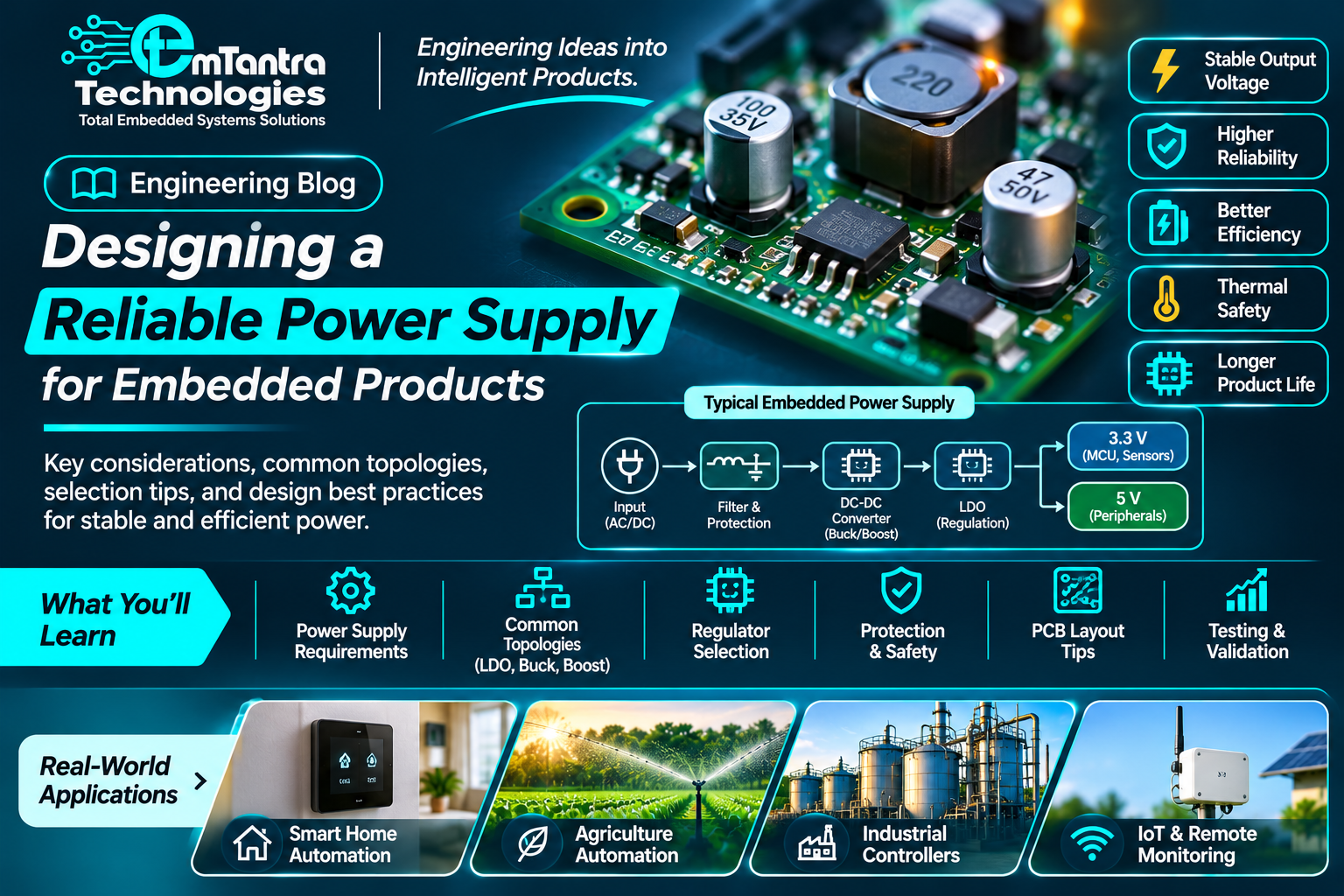
DESIGNING A RELIABLE POWER SUPPLY FOR EMBEDDED PRODUCTS: A PRACTICAL ENGINEERING GUIDE
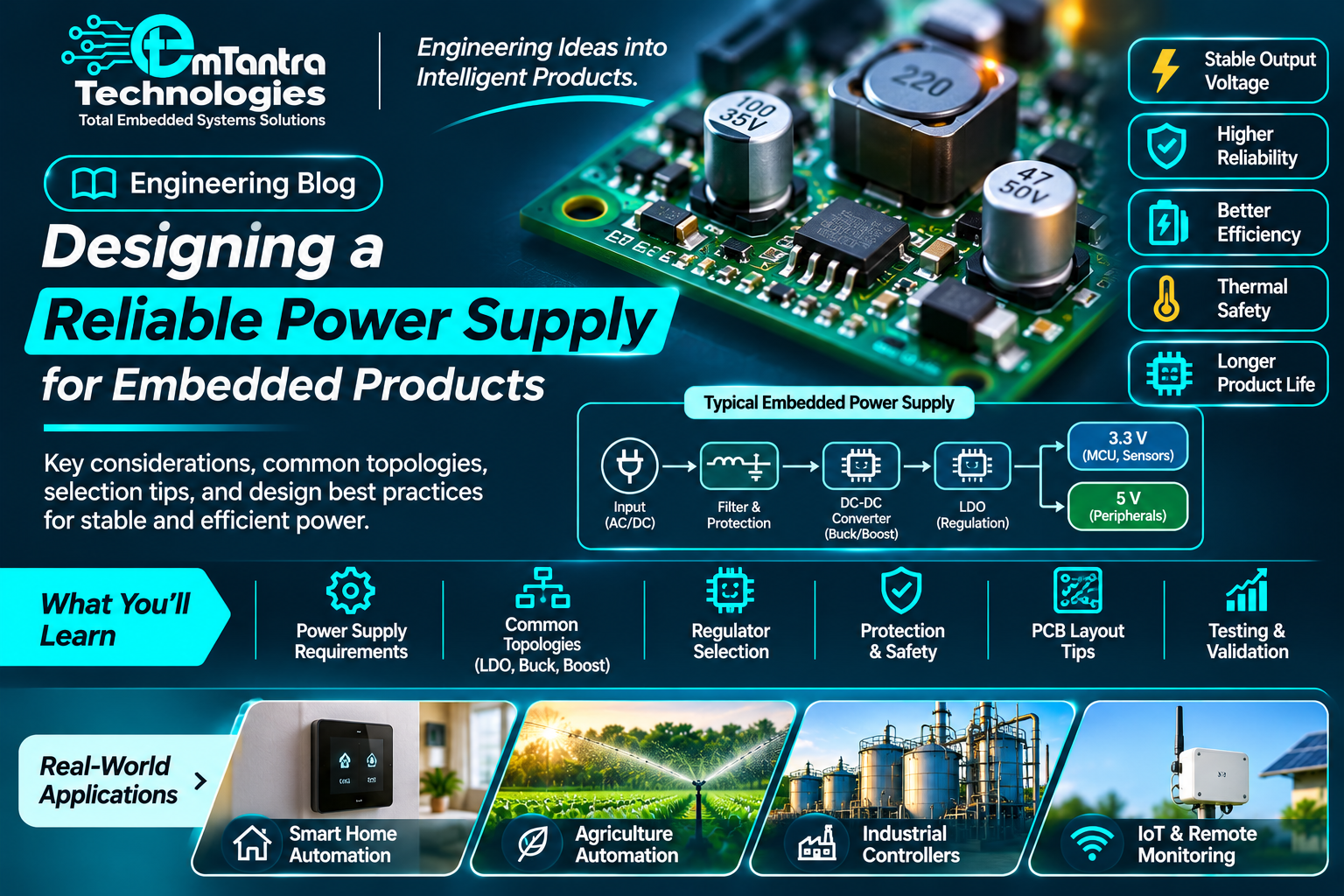
Every embedded electronic product depends on a stable and reliable power supply.
Whether it is a microcontroller-based controller, an IoT device, an industrial monitoring system, or a smart home automation product, the power supply plays a critical role in determining how reliably the system operates.
A product may have a well-designed PCB and carefully developed firmware, but an unstable power supply can still cause unexpected resets, communication failures, inaccurate sensor readings, excessive heating, and even permanent hardware damage.
Power-supply design is therefore not simply about converting one voltage into another. It requires understanding the electrical requirements of every circuit, selecting the right power architecture, managing noise, providing protection, and validating performance under real operating conditions.
At EmTantra Technologies, power-supply design is an important part of our embedded electronics and product engineering work.
UNDERSTANDING THE POWER REQUIREMENTS
Before selecting a regulator or designing a circuit, the first step is to understand the power requirements of the complete product.
Different electronic components operate at different voltage levels.
For example, an embedded product may require:
- 12V for relays or external interfaces
- 5V for displays and peripheral modules
- 3.3V for microcontrollers and sensors
- Lower voltages for specific processors or communication ICs
The design must identify the required voltage rails, maximum current consumption, startup current, peak loads, and operating conditions.
It is also important to consider whether multiple circuits operate simultaneously or whether some loads are activated only occasionally.
Preparing a power budget helps determine the required power-supply capacity and prevents underestimating the actual load.
LINEAR REGULATORS AND LDOs
Linear regulators are commonly used when a stable output voltage is required from a higher input voltage.
Low-dropout regulators, commonly known as LDOs, are particularly useful in embedded designs where low noise, simple implementation, and compact circuit size are important.
Common applications include:
- Supplying power to microcontrollers
- Powering analog sensor circuits
- Providing clean supply rails for measurement circuits
- Local voltage regulation for communication ICs
However, linear regulators dissipate the voltage difference as heat.
The approximate power dissipation is:
Power Dissipation = (Input Voltage − Output Voltage) × Load Current
For example, converting 5V to 3.3V at a load current of 200mA results in approximately 0.34W of regulator power dissipation.
Thermal performance must be checked against the regulator’s package, PCB copper area, ambient temperature, and datasheet limits.
BUCK CONVERTERS: STEPPING DOWN VOLTAGE EFFICIENTLY
A buck converter is a switching regulator used to convert a higher DC voltage into a lower DC voltage.
For example:
12V → 5V
24V → 12V
These converters are widely used in embedded controllers, industrial electronics, automotive electronics, and IoT products.
Their main advantage is higher conversion efficiency compared with linear regulation in many applications.
A typical buck converter includes:
- Switching regulator IC
- Inductor
- Input and output capacitors
- Feedback network
- Switching and protection components
However, switching regulators generate electrical noise and require careful PCB layout.
The switching loop, grounding, component placement, feedback routing, and input/output filtering can significantly influence performance.
BOOST CONVERTERS: INCREASING VOLTAGE
A boost converter increases a lower DC input voltage to a higher output voltage.
For example:
3.7V → 5V
5V → 12V
These converters are useful in battery-powered devices and applications where the required output voltage is higher than the available supply.
A boost converter typically uses a switching IC, inductor, diode or synchronous switching stage, capacitors, and a feedback network.
The design must account for input-current requirements, output-current capability, efficiency, startup behavior, and thermal performance.
POWER SUPPLY NOISE AND ITS EFFECT ON EMBEDDED SYSTEMS
One commonly overlooked issue in embedded product development is power-supply noise.
Switching regulators, relays, motors, wireless modules, and digital circuits can introduce disturbances into the power system.
These disturbances may affect sensitive analog circuits, ADC measurements, communication interfaces, and microcontroller operation.
Possible design practices include:
- Appropriate input and output filtering
- Correct decoupling capacitor placement
- Proper grounding and return-current paths
- Separation of noisy switching sections from sensitive analog circuits
- Suitable PCB routing and copper design
- Verification of ripple and transient response
For measurement-based products, power-supply noise can directly affect measurement accuracy.
For communication-based products, supply disturbances may cause unexpected resets or unreliable operation.
POWER PROTECTION IS ESSENTIAL
A reliable power supply should also protect the electronic product against expected electrical disturbances.
Depending on the application, protection may include:
Overvoltage protection: Helps protect downstream circuits from excessive input voltage.
Undervoltage protection: Prevents operation when the supply falls below the required operating range.
Reverse-polarity protection: Protects against incorrect power connection.
Overcurrent protection: Limits excessive current during abnormal conditions.
Short-circuit protection: Helps prevent damage when an output is shorted.
Surge and transient protection: Helps manage electrical disturbances appropriate to the product’s operating environment.
The protection strategy should be selected according to the input source, load characteristics, applicable safety requirements, and expected operating conditions.
PCB LAYOUT CONSIDERATIONS
Even a correctly selected power-supply IC can perform poorly if the PCB layout is not designed properly.
Important PCB design considerations include:
- Keep high-current switching loops compact.
- Place input bypass capacitors close to regulator pins.
- Follow the regulator manufacturer’s recommended layout.
- Provide suitable copper areas for heat dissipation.
- Keep sensitive analog signals away from noisy switching nodes.
- Route feedback signals carefully.
- Maintain appropriate clearances and creepage distances where required.
In switching power supplies, layout is part of the electrical design itself, not merely a manufacturing consideration.
THERMAL MANAGEMENT
Power components generate heat during operation.
Regulators, switching ICs, MOSFETs, diodes, and inductors must operate within their specified temperature limits.
Thermal design should consider:
- Maximum load current
- Conversion efficiency
- Ambient temperature
- Component package and thermal resistance
- PCB copper area
- Enclosure ventilation
- Continuous versus intermittent operation
A power supply that works during a short laboratory test may still overheat during continuous operation inside an enclosed product.
Thermal testing under realistic load conditions is therefore important.
TESTING AND VALIDATION
Power-supply testing should be performed before integrating the complete product.
Useful validation checks include:
- Output voltage accuracy
- Output ripple and noise
- Startup and shutdown behavior
- Load regulation
- Line regulation
- Transient response
- Efficiency
- Temperature rise
- Overcurrent and short-circuit behavior
- Operation under expected input-voltage variations
Oscilloscopes, electronic loads, multimeters, and suitable thermal measurement equipment help evaluate power-supply performance.
Testing should cover both normal operation and defined abnormal conditions.
DESIGNING FOR REAL-WORLD APPLICATIONS
The ideal power architecture depends on the product.
A battery-powered BLE sensor may prioritize low quiescent current and efficiency.
An industrial controller may require a wider input-voltage range, transient protection, and reliable operation in an electrically noisy environment.
A smart home controller may need multiple voltage rails for the microcontroller, relay drivers, communication modules, and displays.
An IoT gateway may require sufficient power capacity for communication modules with high peak-current demands.
There is no single power-supply circuit suitable for every application. The design must match the actual electrical and environmental requirements.
For mains-powered products, isolation, insulation, creepage and clearance, protective components, and applicable electrical safety standards must be addressed by qualified design and validation.
CONCLUSION
A reliable power supply is one of the foundations of a successful embedded electronic product.
Selecting the right regulator is only one part of the process. Power budgeting, component selection, protection, PCB layout, thermal management, and systematic testing all contribute to dependable operation.
A well-engineered power supply improves system stability, protects electronic components, and supports the long-term reliability of the complete product.
At EmTantra Technologies, we work on electronics design, embedded systems, PCB development, firmware, IoT, and customized product engineering for industrial, agriculture, smart home, and connected-device applications.
Need support with an embedded product or custom power-supply design?
Visit emtantra.com
EmTantra Technologies
Total Embedded Systems Solutions
Engineering Ideas into Intelligent Products.