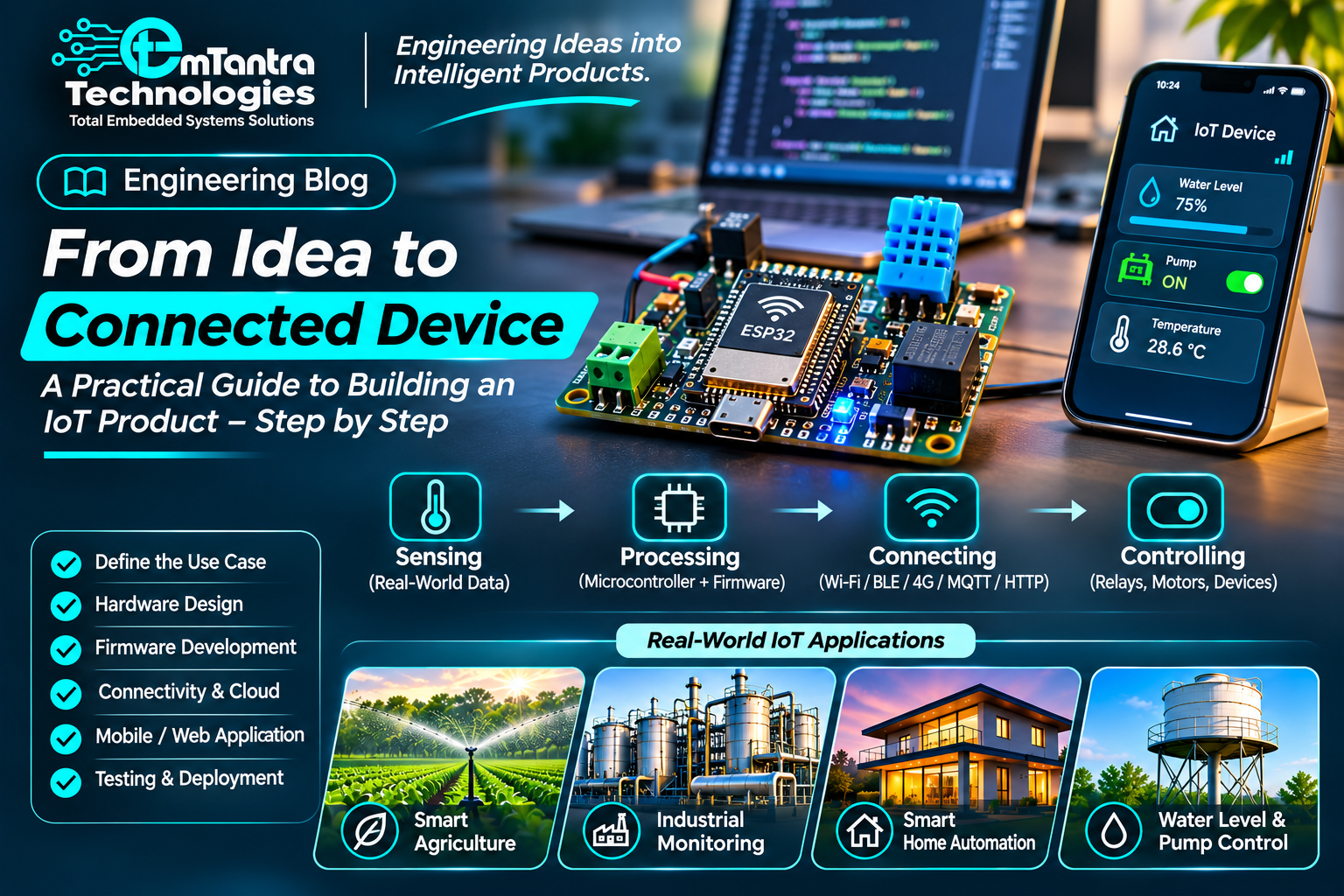
From Idea to Connected Device: A Practical Guide to Building an IoT Product

 EmTantra Technologies
·
·7 min read
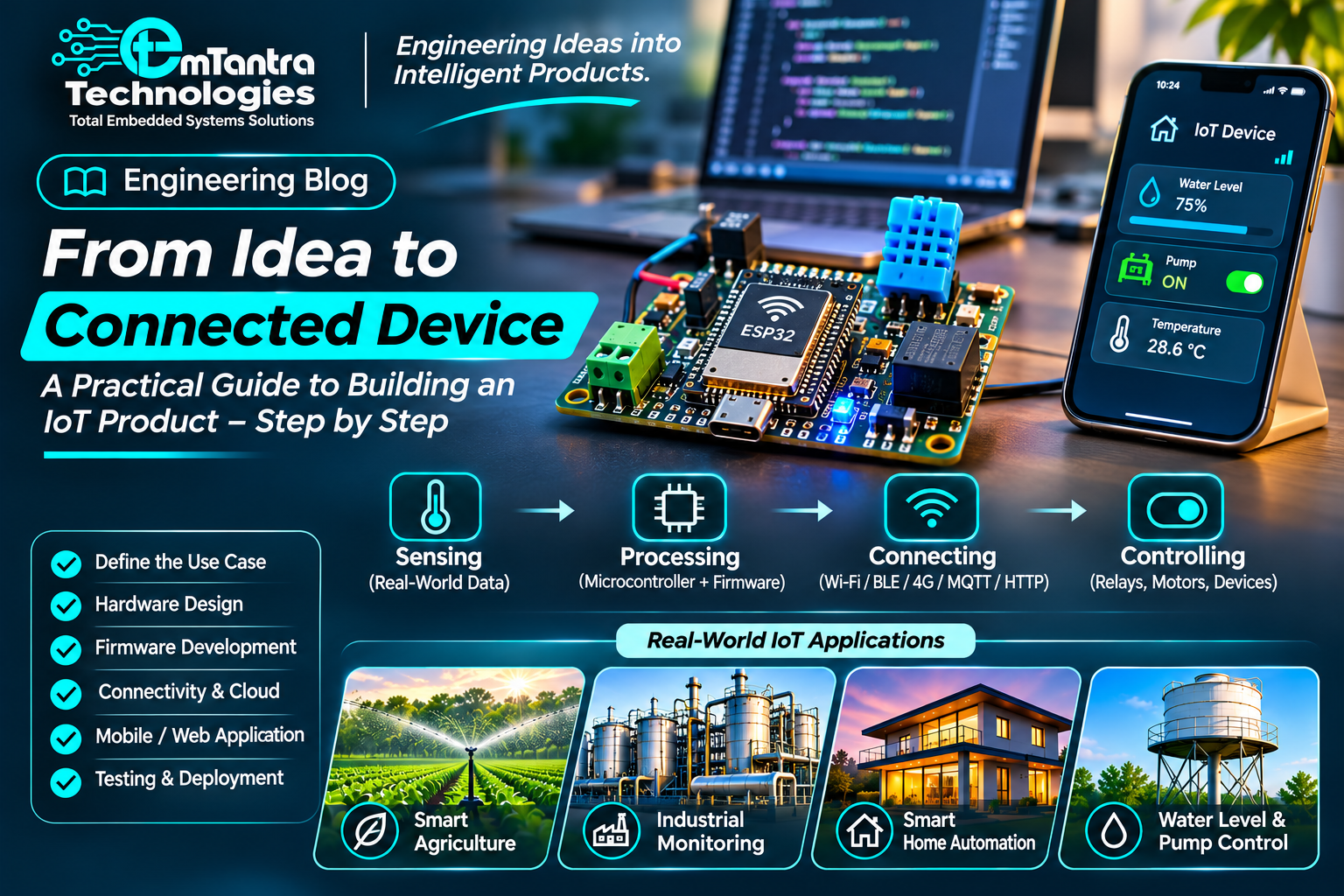
FROM IDEA TO CONNECTED DEVICE: A PRACTICAL GUIDE TO BUILDING AN IoT PRODUCT – STEP BY STEP
Have you ever wondered how an idea becomes a connected electronic product that can monitor equipment, collect sensor data, communicate with the internet, and be controlled through a mobile application?
Behind every successful IoT product is a combination of electronics engineering, embedded firmware, communication technologies, software development, and product testing.
Building an IoT device is not simply a matter of connecting a sensor to a Wi-Fi module. It requires a complete engineering approach, starting with the actual problem and ending with a reliable product ready for real-world use.
At EmTantra Technologies, we work across these engineering stages to help transform ideas into intelligent electronic products.
Let’s understand how an IoT product is developed, step by step.
- START WITH THE PROBLEM, NOT THE TECHNOLOGY
One of the most common mistakes in product development is selecting a microcontroller or communication module before defining what the product needs to achieve.
Start by identifying the problem.
Consider a simple example: a customer wants to monitor and control a water pump remotely.
Before selecting components, define the requirements:
- Monitor the water level in a tank.
- Measure pump operating status.
- Switch the pump ON and OFF.
- Provide manual and automatic operating modes.
- Detect abnormal conditions.
- Display status through a mobile application.
- Allow remote monitoring over the internet.
These requirements become the foundation of the product architecture.
A clear requirement document helps prevent unnecessary features, component changes, and costly redesigns.
- DESIGN THE HARDWARE ARCHITECTURE
Once the requirements are clear, the next step is to define the electronic hardware.
A typical IoT controller may contain:
- Microcontroller
- Sensor interfaces
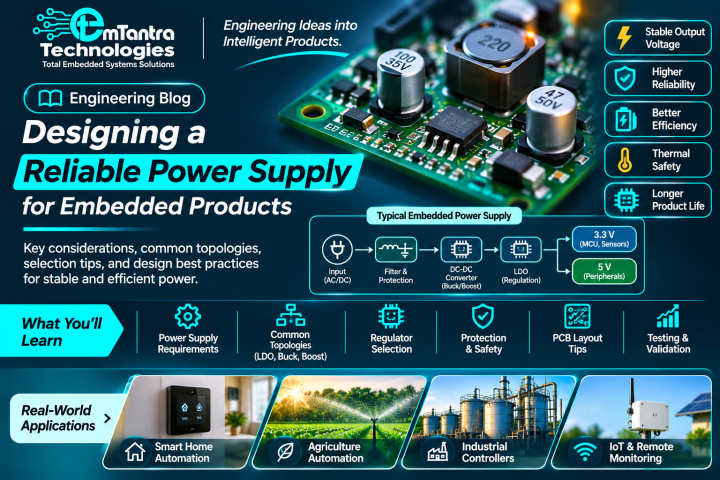
- Power-supply circuit
- Communication module
- Relay or output driver circuits
- Display and user-interface components
- Programming and debugging interface
- Protection circuits
The microcontroller is the central processing unit of the device. It reads sensor information, executes control logic, manages communication, and controls outputs.
Platforms such as ESP32, STM32/8 and other microcontroller families can be considered depending on the application.
The selection should be based on processing requirements, memory, peripheral availability, connectivity, power consumption, cost, and long-term product availability.
- SELECT THE RIGHT SENSORS AND ELECTRONIC COMPONENTS
Sensors allow an IoT product to interact with the physical world.
For a water-management application, the design may require water-level sensors, flow sensors, voltage measurement, or current measurement.
For industrial monitoring, it may require temperature, pressure, vibration, gas, or electrical measurement sensors.
For agriculture automation, soil moisture, temperature, humidity, and water-flow measurements may be useful.
Sensor selection should consider:
- Measurement range
- Accuracy and resolution
- Response time
- Operating voltage
- Interface compatibility
- Environmental conditions
- Calibration requirements
- Cost and availability
The sensor must be suitable for the actual installation environment, not just the laboratory prototype.
- DEVELOP THE CIRCUIT AND PCB
After selecting the components, the electronic circuit is designed and reviewed.
The schematic defines how the microcontroller, sensors, power supply, communication interfaces, and output drivers connect.
The PCB layout then converts the circuit into a physical electronic board.
Important design considerations include:
- Power distribution and grounding
- Signal integrity
- Component placement
- Current-carrying track widths
- Thermal management
- Electromagnetic compatibility
- Connector and enclosure requirements
- Manufacturing and assembly requirements
A PCB should be designed for both electrical performance and manufacturability.
A circuit that works on a development board may require significant optimization before it becomes a compact, production-ready product.
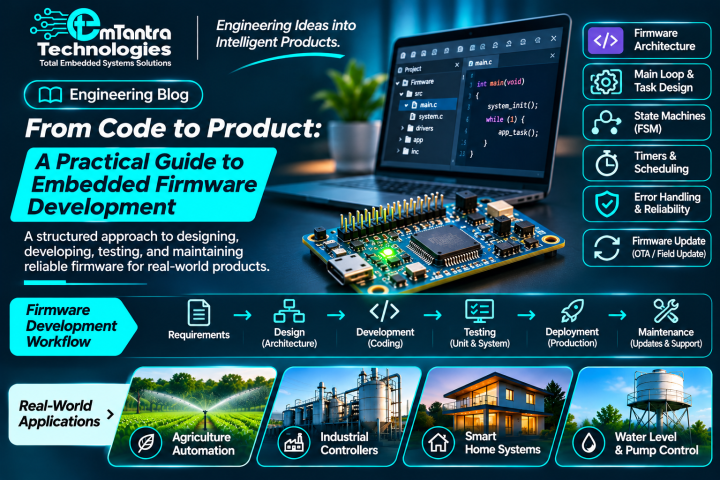
- DEVELOP THE EMBEDDED FIRMWARE
Firmware is the intelligence that makes the hardware perform its intended functions.
It reads sensors, processes measurements, manages communication, controls outputs, and handles abnormal conditions.
For example, firmware in a connected pump controller may:
- Read water-level measurements.
- Check pump operating conditions.
- Apply automatic ON/OFF logic.
- Detect faults and abnormal voltage conditions.
- Update the display.
- Send device status to the server.
- Receive and validate remote commands.
Firmware architecture should be planned carefully.
Depending on the application, the design may use a structured main loop, state machines, interrupt-driven processing, or an RTOS.
Good firmware should also handle communication failures, sensor faults, unexpected resets, and recovery conditions.
- CHOOSE THE RIGHT CONNECTIVITY
An IoT device needs a communication method suitable for its application.
Some commonly used technologies include:
Wi-Fi: Useful for devices installed where a reliable wireless network is available.
Bluetooth Low Energy: Suitable for short-range communication, device configuration, and low-power applications.
4G and cellular connectivity: Useful for remote installations where Wi-Fi is unavailable.
RS485 and Modbus: Commonly used for communication with industrial meters, controllers, and field devices.
Ethernet: Suitable for reliable wired network installations.
MQTT and HTTP: Application-level protocols used to exchange information between devices, servers, and software applications.
The correct choice depends on communication range, network availability, power consumption, data requirements, reliability, and installation cost.
- CONNECT THE DEVICE TO A SERVER OR CLOUD PLATFORM
After the device is operational, it can be connected to a server or cloud platform.
The server acts as a communication and data-management layer between devices and applications.
Typical functions include:
- Device registration and identification
- Receiving sensor measurements
- Storing historical information
- Managing device configuration
- Processing commands
- Generating alerts
- Maintaining device status
A properly designed backend should also consider authentication, access control, data validation, communication security, and device management.
Not every IoT product needs a large cloud infrastructure. The architecture should be selected according to the actual product requirements.
- DEVELOP THE MOBILE OR WEB APPLICATION
The application provides the user interface for interacting with the IoT product.
A typical application may include:
- User registration and login
- Device pairing and configuration
- Live sensor readings
- Device status
- Historical measurements
- Notifications and alerts
- Manual control
- Scheduling and automation
- Device settings
For example, a user may open a mobile application to check tank water level, see whether the pump is running, and issue an authorized control command.
The application should communicate with the backend through well-defined APIs and display device information clearly.
- TEST THE COMPLETE PRODUCT
A working prototype does not automatically mean the product is ready for production.
The complete system must be tested across hardware, firmware, communication, application software, and mechanical integration.
Important testing activities include:
Hardware testing:
Verify voltage rails, current consumption, sensor interfaces, output drivers, and protection circuits.
Firmware testing:
Check control logic, timing, sensor handling, error detection, and recovery behavior.
Communication testing:
Test connection loss, reconnection, message validation, server availability, and command handling.
Application testing:
Verify device pairing, user access, status updates, notifications, and control functions.
Environmental testing:
Evaluate performance under expected temperature, humidity, vibration, and electrical conditions.
Production testing:
Define repeatable checks to verify that every manufactured unit meets the product requirements.
Testing should include abnormal conditions, not just normal operation.
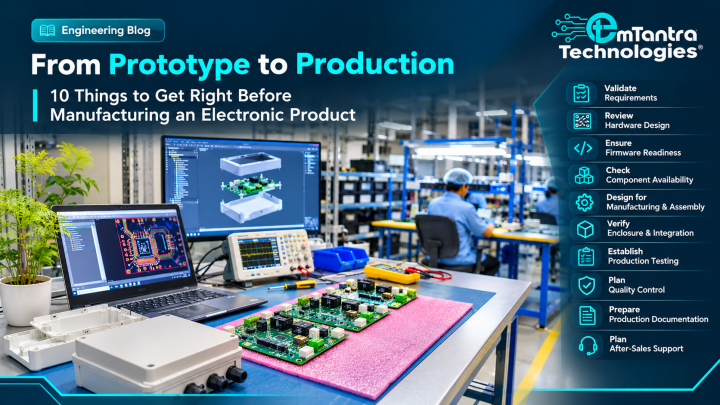
- MOVE FROM PROTOTYPE TO PRODUCTION
The final stage is preparing the product for manufacturing and deployment.
This involves more than producing the PCB.
It may include:
- Final PCB revision
- Component availability review
- Enclosure and mechanical integration
- Assembly documentation
- Firmware programming process
- Production test procedures
- Calibration requirements
- Quality-control checks
- Packaging and delivery preparation
Design-for-manufacturing and design-for-testing should be considered early to avoid expensive changes later.
A structured engineering process helps ensure that the product can be manufactured consistently and maintained throughout its lifecycle.
WHAT MAKES A SUCCESSFUL IoT PRODUCT?
A successful IoT product is not necessarily the one with the most advanced processor or the largest number of features.
It is the product that solves a real problem reliably and economically.
The most important factors are:
- Clear product requirements
- Suitable hardware architecture
- Reliable PCB design
- Efficient and maintainable firmware
- Appropriate communication technology
- Secure and scalable software
- Practical user experience
- Thorough testing
- Manufacturing readiness
All these elements must work together.
CONCLUSION: FROM ENGINEERING IDEA TO INTELLIGENT PRODUCT
Building an IoT product is a multidisciplinary engineering process.
It brings together electronics design, PCB development, embedded firmware, sensors, communication technologies, server integration, application development, and product testing.
When these areas are planned and developed together, an idea can become a practical, reliable, and market-ready connected product.
At EmTantra Technologies, we support embedded product development from concept and hardware design to firmware, IoT integration, prototyping, and testing.
Our engineering solutions cover agriculture automation, industrial monitoring, smart home systems, IoT gateways, water-level controllers, pump automation, and customized connected devices.
Have an idea for an electronic or IoT product?
Let’s discuss how to turn it into a working product.
Visit emtantra.com
EmTantra Technologies
Total Embedded Systems Solutions
Engineering Ideas into Intelligent Products.