From Code to Product: A Practical Guide to Embedded Firmware Development

 EmTantra Technologies
·
·7 min read
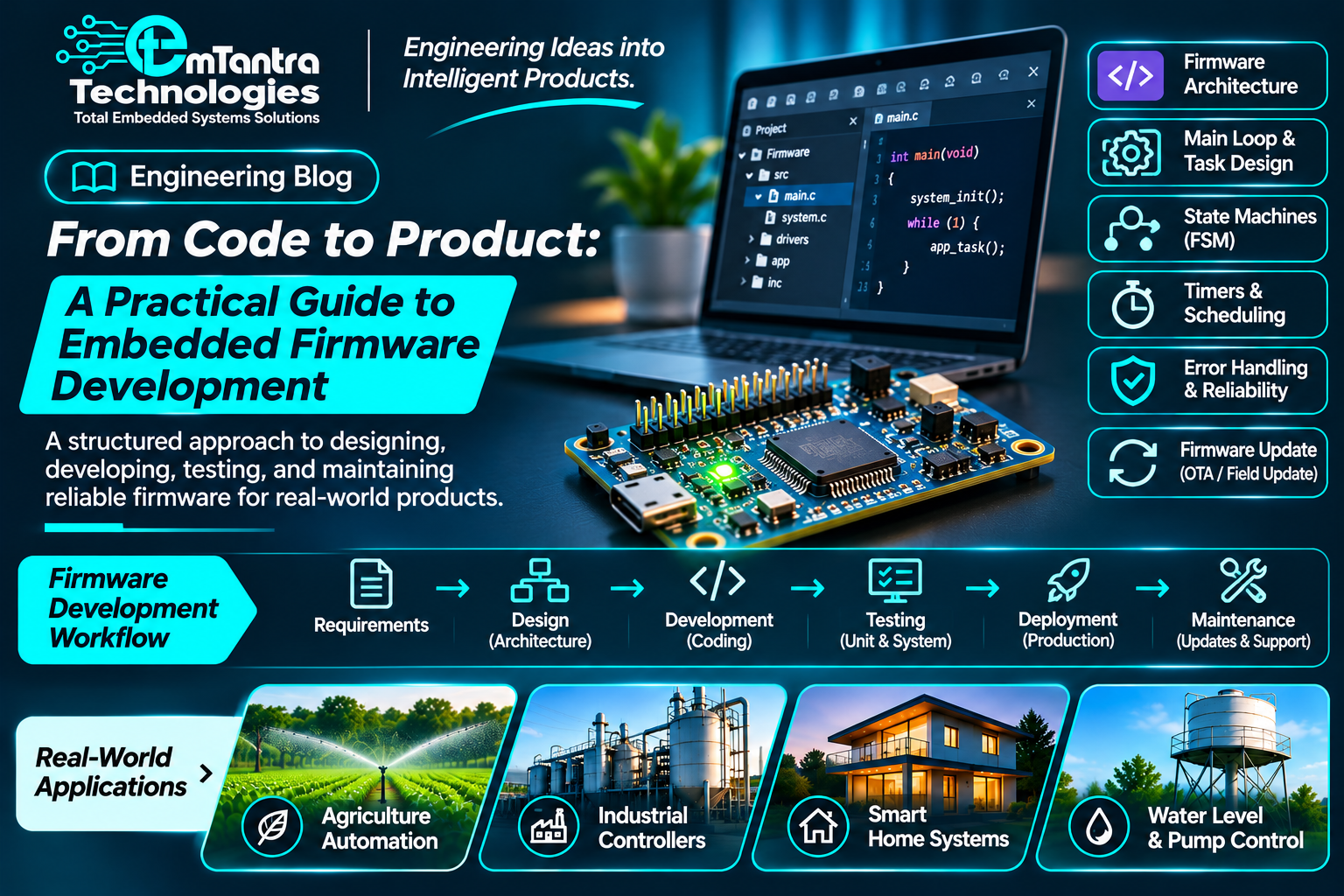
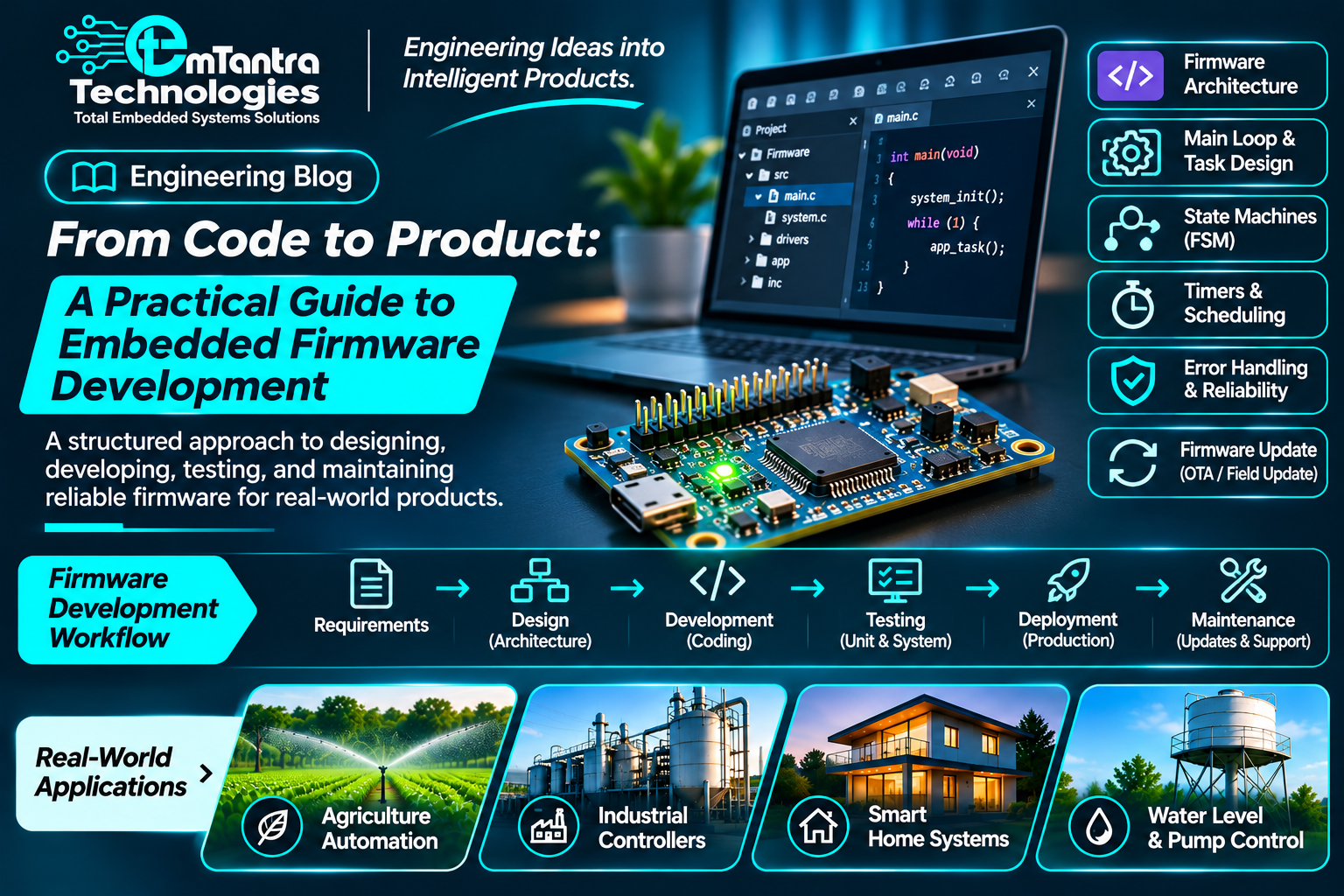
FROM CODE TO PRODUCT: A PRACTICAL GUIDE TO EMBEDDED FIRMWARE DEVELOPMENT
An embedded product is not defined only by its electronic hardware. Its firmware determines how the hardware behaves, processes information, communicates with other devices, and responds to real-world conditions.
A microcontroller may have several peripherals, communication interfaces, timers, and memory resources. But converting these hardware capabilities into a reliable product requires carefully structured firmware.
Whether you are developing an IoT controller, industrial automation system, smart home device, or electronic measurement instrument, firmware architecture plays a major role in the product’s performance and reliability.
At EmTantra Technologies, embedded firmware development is an essential part of our complete product engineering process.
WHAT IS EMBEDDED FIRMWARE?
Embedded firmware is software programmed into a microcontroller or processor to control the operation of an electronic product.
Unlike general-purpose applications, embedded firmware is designed to work closely with specific hardware.
It may perform functions such as:
- Reading sensor measurements
- Controlling relays, motors, and other outputs
- Managing displays and user interfaces
- Communicating with external devices
- Monitoring operating conditions
- Detecting faults and abnormal conditions
- Managing device configuration
- Controlling power and operating modes
Firmware must work within the hardware’s processing speed, memory, timing, and electrical constraints.
- START WITH CLEAR FIRMWARE REQUIREMENTS
Before writing code, define what the firmware must accomplish.
For example, an IoT pump controller may require:
- Reading water-level sensor inputs
- Measuring voltage and current
- Controlling a pump through a relay or contactor interface
- Detecting dry-run conditions
- Handling under-voltage and over-voltage conditions
- Supporting manual and automatic operation
- Communicating with a mobile application or server
- Saving user configuration
These functions should be converted into a clear functional specification.
Also identify timing requirements, operating modes, fault conditions, communication behavior, and recovery procedures.
A well-defined requirement document reduces confusion during firmware development and testing.
- CHOOSE THE RIGHT FIRMWARE ARCHITECTURE
Firmware architecture determines how different functions are organized and executed.
A simple product may operate using a basic main loop, while a more complex product may require a structured state machine or an RTOS.
The architecture should match the complexity of the product.
MAIN LOOP ARCHITECTURE
A main loop repeatedly executes a set of functions.
A simplified structure may look like this:
Initialize hardware
Read inputs
Process application logic
Update outputs
Handle communication
Repeat
This approach is suitable for many simple embedded controllers.
However, as the number of functions increases, the main loop must be carefully structured to avoid long blocking operations and unpredictable response times.
STATE MACHINE ARCHITECTURE
A state machine organizes firmware behavior into clearly defined operating states.
For example, a pump controller may have these states:
- IDLE
- STARTING
- RUNNING
- FAULT
- MANUAL MODE
- AUTOMATIC MODE
Transitions between states occur when specific conditions are met.
For example, if a dry-run condition is detected while the pump is running, the firmware can transition to the FAULT state and disable the pump.
State machines make complex control logic easier to understand, test, and maintain.
REAL-TIME OPERATING SYSTEM
An RTOS can help organize products that need multiple concurrent activities.
Typical tasks may include:
- Sensor acquisition
- Communication handling
- Display updates
- Control logic
- Data logging
- Fault monitoring
An RTOS provides task scheduling and synchronization mechanisms. However, it also introduces additional complexity in memory management, timing, task priorities, and shared-resource handling.
An RTOS should be selected when the product requirements justify it, not simply because the microcontroller supports it.
- PERIPHERAL DRIVER DEVELOPMENT
Microcontrollers provide hardware peripherals that allow firmware to interact with external components.
Common peripherals include:
GPIO: Used for digital inputs and outputs such as switches, LEDs, and relay control signals.
ADC: Converts analog signals into digital values for sensor and measurement applications.
UART: Provides serial communication with modems, GPS modules, and external controllers.
SPI: Commonly used for displays, external memory, and high-speed peripheral communication.
I2C: Used for sensors, RTC devices, EEPROMs, and other integrated circuits.
Timers and PWM: Used for periodic operations, timing measurement, and control signals.
CAN: Used for communication between controllers in automotive and industrial applications.
A well-structured firmware project separates hardware drivers from application logic. This makes the code easier to debug, reuse, and maintain.
- TIMERS, INTERRUPTS, AND NON-BLOCKING DESIGN
Timing is critical in embedded systems.
Some operations must happen at precise intervals, while others should respond immediately to external events.
Timers can be used for:
- Periodic sensor sampling
- Communication timeouts
- PWM generation
- Switch debouncing
- Event scheduling
- Motor control timing
Interrupts allow the processor to respond to selected hardware events without continuously checking for them.
However, interrupt service routines should generally remain short and predictable. Longer processing can be performed in the main application loop or an appropriate task.
Avoiding unnecessary blocking delays is also important.
For example, using long delay functions in a communication or control loop may prevent the firmware from responding to important events on time.
- COMMUNICATION FIRMWARE
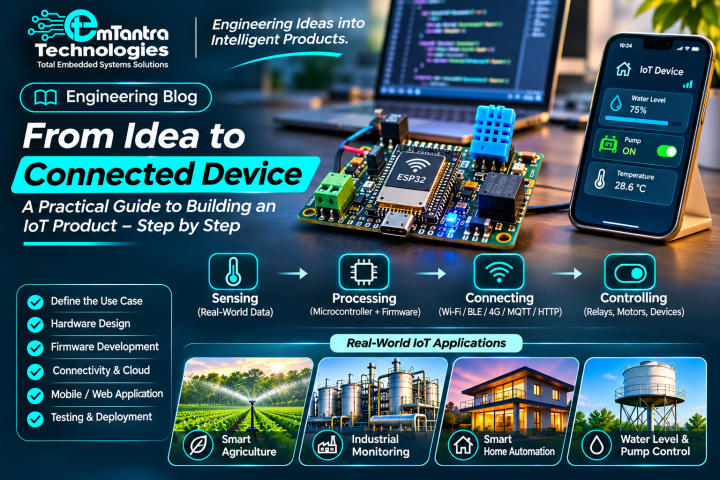
Modern embedded products frequently communicate with external devices and cloud platforms.
Depending on the application, firmware may support:
- UART
- SPI
- I2C
- CAN
- RS485
- Modbus RTU
- Modbus TCP
- MQTT
- HTTP
- BLE
- Wi-Fi
Communication firmware must handle more than simply transmitting and receiving data.
It should also consider:
- Message validation
- Data framing
- Timeouts
- Error detection
- Retry mechanisms
- Connection recovery
- Invalid commands
- Communication interruptions
For connected products, communication failure should not automatically cause the complete device to stop functioning. Critical local control functions should be designed to operate safely when network connectivity is unavailable.
- CONFIGURATION AND NON-VOLATILE MEMORY
Many embedded products need to retain configuration after power is removed.
Examples include:
- Device identification
- Network credentials
- Calibration values
- Operating modes
- Timer settings
- User configuration
This information may be stored in internal Flash, EEPROM, or external non-volatile memory.
Firmware should handle memory updates carefully.
Repeated writes, interrupted updates, invalid configuration values, and memory corruption must be considered.
Where necessary, use validation mechanisms such as checksums, version information, and default configuration recovery.
- ERROR HANDLING AND FIRMWARE RELIABILITY
A reliable firmware design must account for unexpected conditions.
Examples include:
- Sensor disconnection
- Invalid measurement values
- Communication failure
- Power interruption
- Unexpected reset
- Peripheral malfunction
- Incorrect user commands
The firmware should define how each condition is detected and handled.
Watchdog timers can help recover from certain firmware lockups, but they are not a replacement for correct software architecture.
Fault handling should also ensure that outputs move into safe states when required by the application.
- DEBUGGING AND TESTING
Firmware development does not end when the code compiles successfully.
Testing and debugging are essential to verify actual hardware behavior.
Useful debugging methods include:
UART logging: Helps monitor firmware execution, sensor values, and communication messages.
Breakpoints: Allow developers to pause execution and inspect program state.
JTAG and SWD: Provide debugging access to supported microcontrollers.
Oscilloscopes and logic analyzers: Help examine timing, signals, communication buses, and peripheral behavior.
Unit testing: Helps verify individual software functions.
Integration testing: Checks whether firmware modules work correctly together.
System testing: Validates the complete product under realistic operating conditions.
Testing should cover normal operation, boundary conditions, abnormal inputs, and recovery behavior.
- FIRMWARE UPDATES AND PRODUCT MAINTENANCE
Many connected products need firmware updates after deployment.
An update mechanism may use a wired programming interface, a local communication interface, or Over-The-Air (OTA) updates.
A reliable update process should consider:
- Firmware image validation
- Version management
- Power failure during updates
- Recovery from unsuccessful updates
- Authentication and access control
- Compatibility with existing hardware
For products deployed in the field, update and maintenance planning should be considered during the initial architecture design.
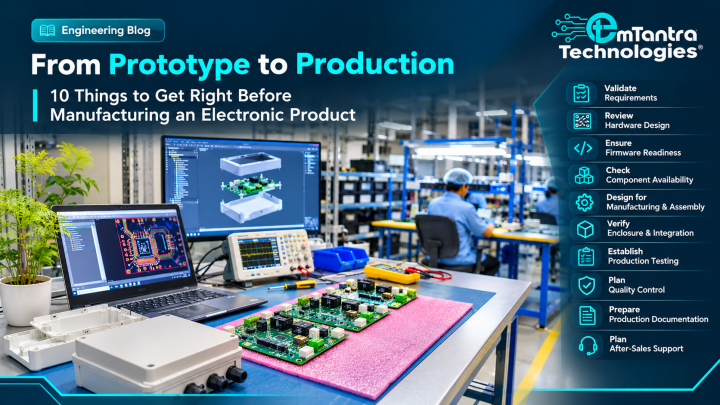
- BUILDING FIRMWARE FOR PRODUCTION
Firmware written for a laboratory prototype may need further engineering before production.
Production firmware should be reviewed for:
- Memory and processor utilization
- Timing and response performance
- Error handling
- Configuration management
- Debugging and logging strategy
- Hardware compatibility
- Code maintainability
- Version control and release management
- Production programming and testing
Documentation is equally important. Firmware versions, hardware revisions, configuration details, and release notes should be maintained throughout the product lifecycle.
CONCLUSION
Embedded firmware is the intelligence behind an electronic product.
Good firmware development requires more than writing code. It involves understanding hardware, defining requirements, selecting the right architecture, managing timing, handling communication, designing fault recovery, and validating the complete system.
A structured firmware development process helps transform a working prototype into a reliable electronic product.
At EmTantra Technologies, we work on embedded firmware, microcontroller programming, electronics design, PCB development, IoT, and customized automation solutions.
Have an embedded product idea or need firmware development support?
Visit emtantra.com
EmTantra Technologies
Total Embedded Systems Solutions
Engineering Ideas into Intelligent Products.