10 Things to Get Right Before Manufacturing an Electronic Product

 EmTantra Technologies
·
·6 min read
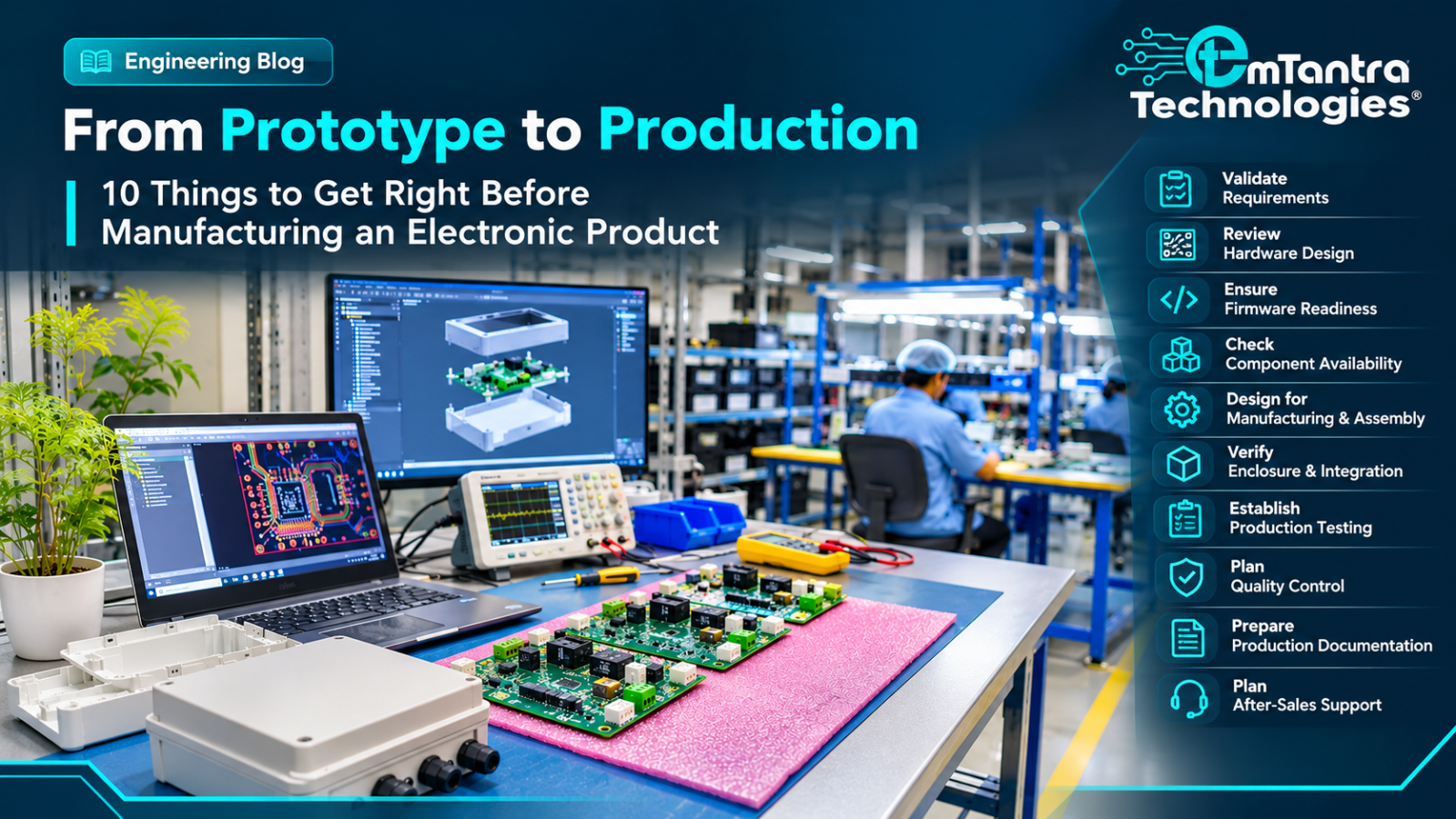
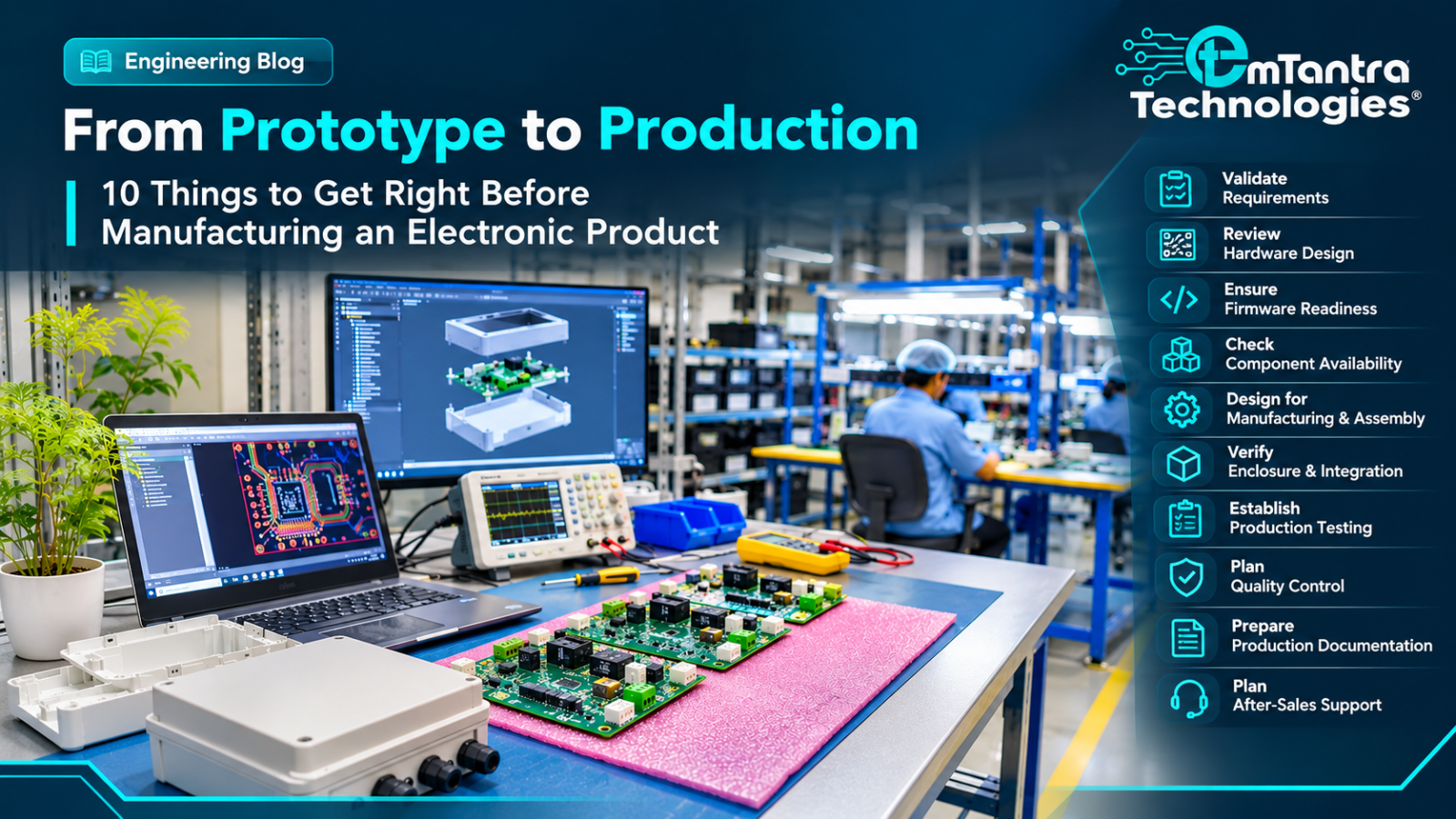
FROM PROTOTYPE TO PRODUCTION: 10 THINGS TO GET RIGHT BEFORE MANUFACTURING AN ELECTRONIC PRODUCT
Turning an electronic product idea into a working prototype is an exciting milestone. The first PCB is assembled, the firmware is running, and the product begins performing its intended functions.
But there is an important difference between building one working prototype and manufacturing hundreds or thousands of reliable products.
A prototype demonstrates that an idea can work. Production engineering ensures that the product can be manufactured consistently, tested properly, delivered reliably, and supported throughout its lifecycle.
Many electronic product development challenges appear only when moving from prototype to production. Component availability, assembly consistency, enclosure integration, testing requirements, documentation, and quality control can all affect the final outcome.
In this article, we explore ten important considerations before taking an electronic product into manufacturing.
- VALIDATE THE PRODUCT REQUIREMENTS
Before moving towards production, revisit the original product requirements.
Does the prototype perform all the functions expected from the final product?
Check whether the product meets its intended requirements for:
- Functional performance
- Operating conditions
- Electrical characteristics
- User interaction
- Communication and connectivity
- Environmental conditions
- Safety and protection
- Installation and maintenance
A prototype that demonstrates only the primary function may still have unresolved requirements.
A structured validation process helps identify these gaps before manufacturing begins.
- REVIEW THE HARDWARE DESIGN
The hardware should be evaluated as a complete system rather than as an individual PCB.
Consider the power supply, electronic components, interfaces, connectors, protection, and mechanical integration.
The review should establish whether the design is suitable for its intended operating environment.
Pay particular attention to electrical performance, component ratings, thermal behaviour, and compatibility between different sections of the product.
Any unresolved hardware issues should be addressed before production release.
- VERIFY FIRMWARE AND SOFTWARE MATURITY
Firmware that works during a demonstration may not yet be ready for continuous operation.
Production firmware should be evaluated for reliability, error handling, configuration management, recovery behaviour, and compatibility with the intended hardware.
The complete product should be tested under normal operating conditions as well as expected abnormal conditions.
Where a product includes a mobile application, server, or cloud platform, these elements must also be validated as part of the complete system.
- CHECK COMPONENT AVAILABILITY
One of the most common challenges in electronics manufacturing is component availability.
A component selected during prototyping may later become difficult to source, have a long lead time, or become unavailable.
Before production, review:
- Manufacturer and distributor availability
- Component lifecycle status
- Lead times
- Minimum order quantities
- Alternative sourcing options
- Long-term supply considerations
Critical components should receive particular attention.
Component selection should balance technical suitability, quality, cost, and availability.
A design that depends on an unreliable supply chain can create serious production delays.
- DESIGN FOR MANUFACTURING AND ASSEMBLY
A product should be designed with its manufacturing process in mind.
Design for Manufacturing (DFM) and Design for Assembly (DFA) help identify issues that may affect fabrication, component placement, soldering, inspection, and final assembly.
Consider:
- Assembly accessibility
- Component placement suitability
- Connector positioning
- Mechanical alignment
- Manufacturing tolerances
- Ease of inspection
- Ease of servicing
The objective is to make the product easier to manufacture consistently without compromising its intended performance.
- VERIFY THE ENCLOSURE AND MECHANICAL INTEGRATION
An electronic product is more than its PCB.
The enclosure, mounting arrangement, connectors, switches, display, cable entry, and installation method all contribute to the final product.
Before production, verify:
- PCB and enclosure compatibility
- Mounting arrangements
- Connector accessibility
- Display and button alignment
- Cable routing
- Ventilation and thermal considerations
- Environmental protection requirements
- Installation and maintenance access
A prototype PCB may work perfectly on a workbench but encounter mechanical difficulties when installed inside the final enclosure.
Mechanical validation should therefore happen before production approval.
- ESTABLISH A REPEATABLE TESTING PROCESS
Testing one prototype is not enough to establish production quality.
Every manufactured unit should undergo appropriate verification based on the product requirements.
A production testing strategy may include:
- Visual inspection
- Power-on verification
- Functional testing
- Interface verification
- Communication checks
- Output verification
- Calibration where required
- Final assembly inspection
Testing should be repeatable and clearly documented.
The purpose is to ensure that every manufactured unit meets the defined acceptance criteria.
- PLAN QUALITY CONTROL
Quality should not depend only on the final inspection.
It must be considered throughout the manufacturing process.
A quality-control plan should define inspection stages, acceptance criteria, handling of rejected units, corrective actions, and traceability requirements.
For example, manufacturing teams should have a clear process for identifying and recording units that fail testing.
This helps prevent defective products from reaching customers and makes it easier to investigate recurring problems.
- PREPARE PRODUCTION DOCUMENTATION
Good documentation is essential when multiple people or teams are involved in manufacturing.
Production documentation may include:
- Approved product specifications
- Manufacturing and assembly documentation
- Bill of Materials
- Approved design revisions
- Firmware release information
- Test procedures
- Quality inspection criteria
- Product labelling requirements
- Packaging instructions
Documentation should clearly identify the approved product revision.
Without proper revision control, different manufacturing batches may accidentally use different design versions.
- PLAN AFTER-SALES SUPPORT AND PRODUCT MAINTENANCE
The product development process does not end when the units are delivered.
A production-ready product should also have a support and maintenance plan.
Consider:
- Installation documentation
- User instructions
- Troubleshooting information
- Spare-part availability
- Service procedures
- Firmware maintenance where applicable
- Warranty and support arrangements
For connected products, long-term server availability, device management, and software maintenance may also be important.
Planning these aspects early makes it easier to support customers after deployment.
THE IMPORTANCE OF A COMPLETE PRODUCT ENGINEERING APPROACH
Electronic product development involves several interconnected engineering disciplines.
Hardware design, PCB development, firmware, enclosure design, testing, and manufacturing cannot always be treated as independent activities.
A change in one area may affect several others.
For example, changing a component may influence PCB layout, firmware compatibility, thermal behaviour, enclosure requirements, and production testing.
A coordinated engineering approach helps identify these dependencies early and reduces unnecessary redesign.
FINAL THOUGHT: A WORKING PROTOTYPE IS ONLY THE BEGINNING
Moving from prototype to production is one of the most important stages in electronic product development.
The objective is not simply to reproduce a working prototype. It is to create a product that can be manufactured consistently, tested reliably, delivered confidently, and maintained throughout its lifecycle.
Successful product development requires attention to engineering quality, manufacturability, component sourcing, documentation, testing, and customer requirements.
At EmTantra Technologies, we work on embedded product engineering, electronics design, PCB development, firmware, IoT, and customized automation solutions.
From initial concepts and prototypes to product integration and production preparation, our focus is on transforming engineering ideas into practical electronic products.
Planning to take your electronic product from prototype to production?
Visit emtantra.com to explore our engineering capabilities.
EmTantra Technologies
Total Embedded Systems Solutions
Engineering Ideas into Intelligent Products.