Why RS485 Is Still Important in Industrial IoT

 EmTantra Technologies
·
·8 min read
Why RS485 Is Still Important in Modern Industrial IoT Systems
Industrial automation is evolving rapidly. Modern factories, pumping stations, energy monitoring systems, and industrial equipment are becoming increasingly connected.
Wireless technologies, cloud platforms, and IoT applications are transforming how industries monitor and control equipment. However, one communication technology continues to play an important role in industrial environments: RS485.
Despite being an established technology, RS485 remains widely used in industrial controllers, energy meters, temperature controllers, PLCs, and IoT gateways.
Why is this technology still relevant when modern wireless communication is available?
The answer lies in its simplicity, differential signalling, multi-device communication capability, and suitability for industrial applications.
At EmTantra Technologies, RS485 and Modbus communication are important technologies in our embedded controllers, industrial monitoring systems, and IoT gateway development.
What Is RS485?
RS485 is an electrical interface standard that defines how devices exchange serial data using differential signalling.
Unlike conventional UART communication, which typically uses separate transmit and receive signals referenced to ground, RS485 uses two signal lines, commonly called A and B.
The receiver determines the transmitted data based on the voltage difference between these two lines.
This differential signalling provides better resistance to common-mode electrical noise, making RS485 suitable for many industrial environments.
RS485 is a physical-layer standard. It does not independently define how the transmitted data should be structured or interpreted.
This is where protocols such as Modbus RTU become useful.
Why Is RS485 Suitable for Industrial Applications?
Industrial installations often have challenging electrical environments.
Motors, contactors, variable-frequency drives, switching power supplies, and long cable installations can introduce electrical interference.
RS485 offers several practical advantages.
- Differential communication
RS485 uses differential signalling, which helps reject electrical noise that affects both signal conductors similarly.
This makes it suitable for communication in electrically noisy environments when properly installed.
- Long-distance communication
RS485 supports communication over substantially longer distances than typical PCB-level serial interfaces.
The achievable distance depends on cable characteristics, data rate, network topology, loading, and installation conditions.
- Multiple devices on a shared bus
RS485 supports multi-drop network configurations, allowing multiple devices to communicate over a shared differential pair.
The number of devices depends on receiver loading, transceiver specifications, and network design.
- Simple hardware implementation
RS485 transceivers are available in compact packages and can be integrated with common microcontrollers.
A microcontroller with a UART peripheral can communicate with an RS485 network through a suitable transceiver.
- Industrial ecosystem compatibility
Many industrial instruments and controllers already provide RS485 interfaces, making integration with existing systems easier.
Understanding RS485 and Modbus RTU
RS485 and Modbus RTU are often used together, but they are not the same technology.
RS485 defines the electrical communication interface.
Modbus RTU defines how devices exchange structured data, including device addressing, function codes, register information, and error checking.
For example, an embedded controller can communicate with an industrial energy meter using:
- UART peripheral in the microcontroller
- RS485 transceiver
- Two-wire differential communication cable
- Modbus RTU protocol implementation
The controller can request voltage, current, power, energy consumption, and other available measurements from the meter.
This combination is commonly used in industrial energy monitoring and automation systems.
How Does an RS485 Network Work?
A typical two-wire RS485 network uses a shared differential communication bus.
Multiple devices connect to the same A and B communication lines.
A simplified industrial network may contain:
- One embedded controller or gateway
- Multiple energy meters
- Temperature controllers
- Pressure monitoring instruments
- PLCs and other field devices
In a typical Modbus RTU implementation, one client initiates communication with addressed server devices.
The server responds to valid requests.
The communication parameters must be configured consistently, including:
- Baud rate
- Data bits
- Parity
- Stop bits
- Device address
- Protocol timing
Incorrect configuration can result in communication failures even when the physical wiring is correct.
Important RS485 Hardware Design Considerations
Reliable RS485 communication depends on correct hardware implementation.
- RS485 transceiver selection
The transceiver must be selected according to supply voltage, logic-level compatibility, data rate, receiver sensitivity, common-mode voltage range, protection requirements, and application conditions.
- Bus termination
Termination resistors are generally used at the physical ends of a transmission line to reduce signal reflections.
The termination value should match the cable’s characteristic impedance.
Incorrect or excessive termination can affect signal quality and increase loading.
- Biasing resistors
Biasing establishes a defined bus state when no device is actively transmitting.
The bias network must be designed according to the transceiver characteristics and network topology. Some transceivers provide integrated fail-safe behavior.
- Cable selection
A suitable twisted-pair cable helps maintain signal integrity.
Cable impedance, shielding, grounding, installation length, and environmental conditions should be considered.
- Isolation and surge protection
Industrial installations may experience ground-potential differences and electrical transients.
Depending on the application, isolated RS485 interfaces, surge protection, and suitable PCB protection components may be required.
Developing RS485 Firmware
Hardware is only one part of the implementation. Firmware must also manage communication correctly.
A typical microcontroller-based RS485 implementation includes:
- UART initialization
- Baud-rate configuration
- RS485 transmit and receive control
- Driver-enable signal management
- Message framing
- Data reception and validation
- CRC checking for Modbus RTU
- Response timeout handling
- Communication error detection
- Retry and recovery mechanisms
One important detail is the direction control of a half-duplex RS485 transceiver.
The firmware must enable transmission, send the complete message, wait until the UART has finished transmitting, and then return the transceiver to receive mode.
Switching to receive mode too early can truncate the transmitted message.
A reliable implementation should also handle invalid responses, missing devices, bus timeouts, and communication interruptions.
RS485 in Industrial IoT Gateways
One of the most useful applications of RS485 is connecting existing industrial equipment to modern IoT platforms.
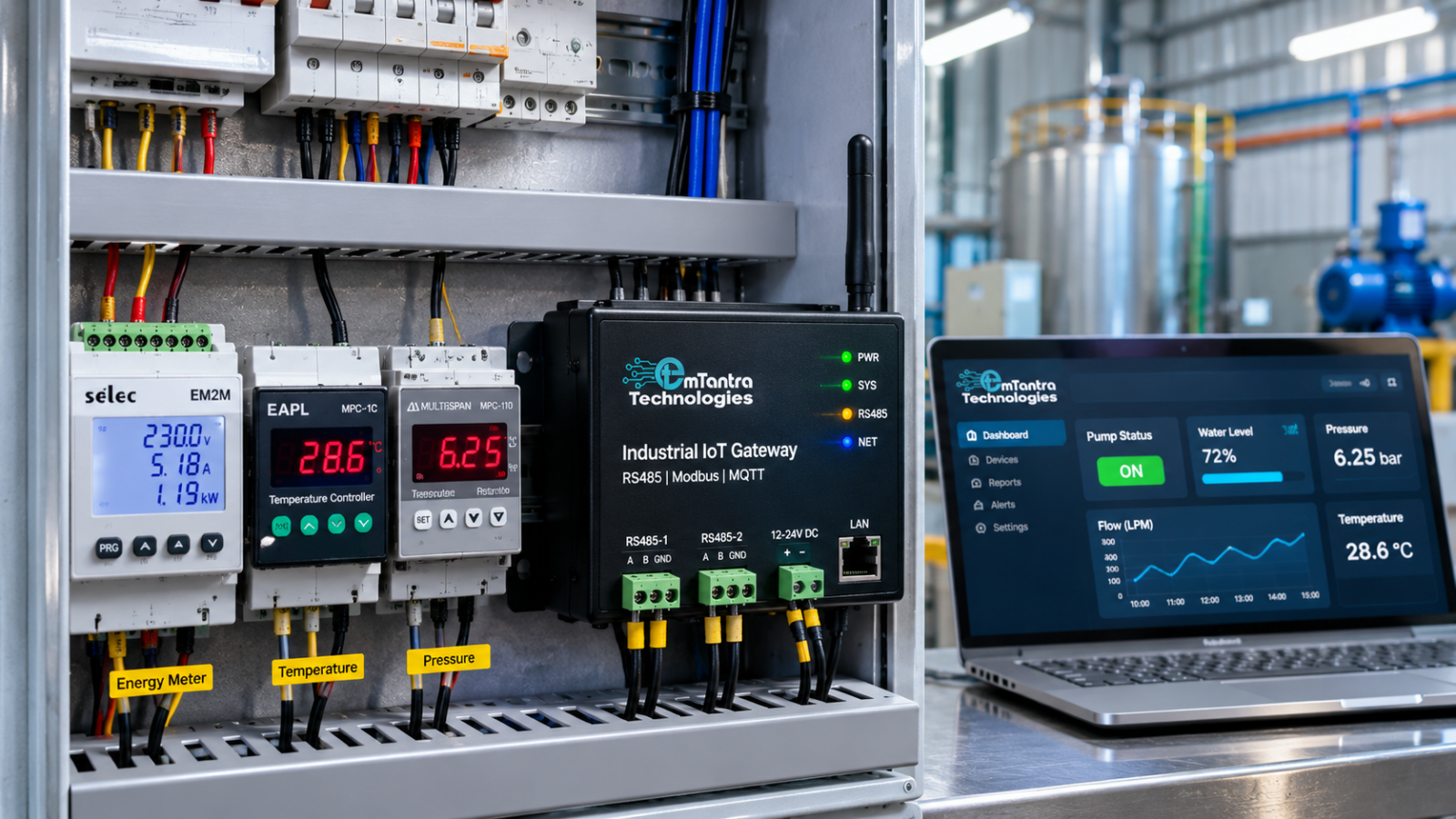
Consider an industrial facility containing multiple energy meters, temperature controllers, and pressure instruments.
Instead of replacing these devices with wireless versions, an embedded IoT gateway can collect their information through RS485.
A typical architecture looks like this:
Industrial Instruments → RS485 / Modbus RTU → Embedded IoT Gateway → Ethernet / Wi-Fi / 4G → Server or Cloud Platform
The gateway performs several functions:
- Polls connected instruments
- Reads Modbus registers
- Converts device data into structured information
- Monitors communication errors
- Sends measurements to a server
- Receives authorized configuration or control commands
- Provides a connection between legacy equipment and modern applications
Depending on the application, the gateway may use MQTT or HTTP to communicate with the backend.
This architecture helps industries introduce remote monitoring without completely replacing their existing field equipment.
Practical Applications of RS485
RS485 is used in several industrial and commercial applications.
Energy monitoring
Multiple energy meters can be connected to a central controller to collect electrical measurements and consumption data.
Industrial temperature monitoring
Temperature controllers and measurement instruments can communicate with a central monitoring system.
Pump and motor monitoring
Controllers and compatible instruments can exchange operating status and measurement information.
Building automation
RS485 networks are commonly used in HVAC controllers, energy management systems, and building automation equipment.
Industrial process monitoring
Pressure, temperature, flow, and other process instruments can be integrated into a central monitoring architecture.
IoT retrofit projects
Existing equipment with RS485 interfaces can be connected to IoT gateways for remote monitoring and data collection.
Common RS485 Communication Problems
Even though RS485 is relatively simple to implement, installation and configuration mistakes can cause unreliable communication.
Some common problems include:
- Incorrect A/B wiring
- Missing or incorrectly placed termination resistors
- Incorrect baud rate or parity settings
- Incorrect device addresses
- Poor cable quality
- Improper grounding
- Electrical interference
- Incorrect transceiver direction control
- Modbus timeout and CRC errors
- Multiple devices transmitting simultaneously
Troubleshooting should begin with checking the physical connections and configuration.
An oscilloscope or suitable differential probe can help examine the communication waveform. A USB-to-RS485 adapter and Modbus diagnostic software are also useful during development and field testing.
Is RS485 Still Relevant in the Age of Wireless IoT?
Absolutely.
Wireless technologies are useful in many applications, but they do not eliminate the need for wired industrial communication.
RS485 is particularly useful when devices are installed in fixed locations, communication reliability is important, and existing instruments already support serial interfaces.
In many modern IoT systems, wired and wireless technologies work together.
RS485 handles communication between field instruments and an embedded gateway, while Wi-Fi, Ethernet, or cellular connectivity connects the gateway to a monitoring platform.
This combination provides a practical approach to modernizing industrial equipment.
Conclusion
RS485 continues to be an important communication technology in industrial automation and IoT systems.
Its differential signalling, multi-device network capability, established industrial ecosystem, and compatibility with Modbus RTU make it a practical choice for connecting controllers, meters, sensors, and industrial instruments.
For engineers developing embedded products and industrial IoT gateways, understanding RS485 hardware design, firmware implementation, network configuration, and troubleshooting is essential.
At EmTantra Technologies, we work on embedded product engineering, RS485 and Modbus integration, industrial IoT gateways, communication interfaces, and customized monitoring and automation systems.
Whether you are developing a new industrial controller or connecting existing equipment to an IoT platform, the right communication architecture makes a significant difference.
Have an industrial IoT or embedded communication project?
Visit emtantra.com to explore our engineering capabilities.
EmTantra Technologies
Total Embedded Systems Solutions
Engineering Ideas into Intelligent Products.