Automatic Water Level Controller: Smarter Water Management with Intelligent Pump Automation

 EmTantra Technologies
·
·6 min read
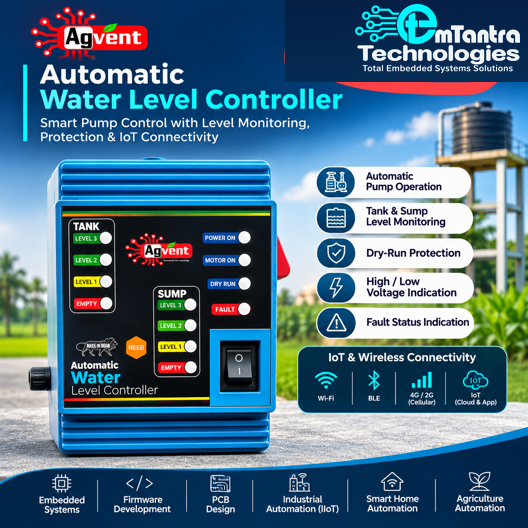
# Agvent Automatic Water Level Controller: Smarter Water Management with Intelligent Pump Automation
Introduction
Reliable water management is important in homes, apartments, commercial buildings and agricultural applications. Water pumps are essential for transferring water between sumps, storage tanks and distribution systems. However, manually monitoring water levels and operating pumps can be inconvenient and may lead to water wastage, unnecessary pump operation or equipment damage.
The Agvent Automatic Water Level Controller, from EmTantra Technologies, is designed to simplify this process through automatic pump control, tank and sump level indication, and important operating-status alerts.
By bringing together embedded electronics and practical automation, the controller helps users manage water storage and pump operation more conveniently.
1. Why Automatic Water Level Control Matters
In a conventional water storage system, users often need to check tank levels manually and operate the pump when required.
This can create several challenges:
- Overflow when a pump is not switched off at the appropriate time
- Water shortages when a tank is not refilled in time
- Unnecessary pump operation
- Difficulty monitoring underground sump water availability
- Limited visibility of pump operating conditions
- Increased dependence on manual supervision
An automatic water level controller helps address these everyday challenges by monitoring water-level conditions and managing pump operation according to the system's operating requirements.
2. Tank and Sump Level Monitoring
A useful water management system needs visibility of both the water source and the storage tank.
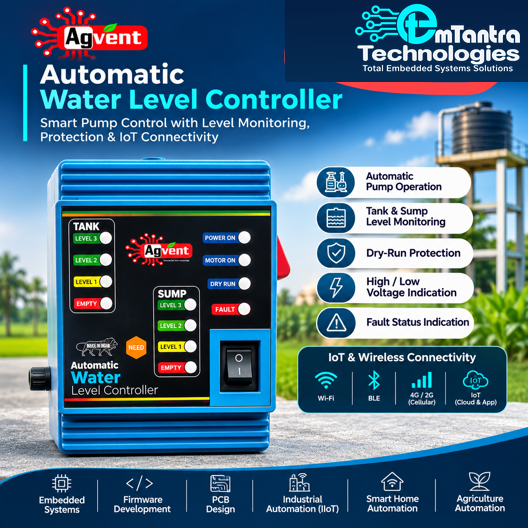
The Agvent controller provides separate level indications for the tank and sump. Its front panel displays multiple level conditions, allowing users to understand the water availability at a glance.
The level indication helps users identify:
- Empty condition
- Low water level
- Intermediate water level
- Higher water level
Monitoring both locations helps the system manage water transfer more effectively and makes it easier for users to understand the overall water storage condition.
3. Automatic Pump Operation
Automatic pump operation reduces the need for users to repeatedly switch the motor on and off.
Based on the configured water-level conditions, the controller can manage the pump operation to support water transfer between the source and storage tank.
This is useful in applications such as:
- Overhead tank filling
- Underground sump to overhead tank transfer
- Residential water supply
- Apartment and commercial buildings
- Agricultural water storage systems
Automatic operation can make routine water management more convenient and consistent.
4. Dry-Run Protection
Dry running occurs when a pump operates without an adequate water supply.
This condition can occur when a sump or water source becomes empty or when water availability is interrupted. Continued operation without sufficient water can cause excessive heating, mechanical stress and damage to pump components.
Dry-run protection is therefore an important consideration in pump automation.
The Agvent controller provides a dry-run status indication to help identify this operating condition and support pump protection.
The protection approach should always be matched to the pump type and installation requirements.
5. Electrical Status and Fault Indication
Electrical supply conditions can affect the performance and safety of motor-driven equipment.
The controller provides high/low voltage status indication along with a fault indicator, helping users identify abnormal operating conditions more easily.
Its front panel also provides dedicated indicators for:
- Power ON
- Motor ON
- Dry-run status
- Fault status
Clear status indication makes the controller easier to monitor during normal operation and troubleshooting.
Appropriate electrical protection and installation practices remain essential for safe pump operation.
6. A Clear and Practical User Interface
A controller should not only automate operation; it should also make system status easy to understand.
The Agvent controller uses dedicated front-panel indicators for tank levels, sump levels and operating conditions. This gives users a quick visual reference without requiring them to interpret complicated displays.
A clear interface is particularly useful in residential and agricultural installations where the system may be operated by people with different levels of technical experience.
7. IoT and Wireless Connectivity in Modern Water Management
Water management systems can benefit from connected monitoring, especially when pumps and storage tanks are installed away from the user.
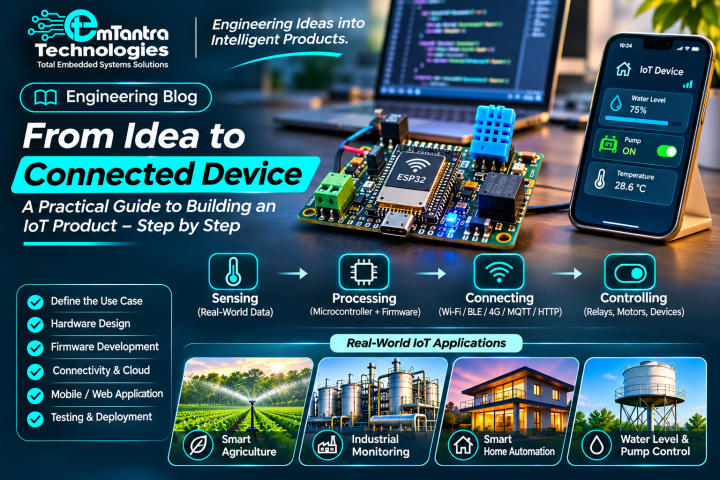
IoT connectivity can extend automation by enabling selected operating information to be viewed remotely. Depending on the product configuration and application requirements, wireless connectivity options may include:
- Wi-Fi for local network and internet connectivity
- Bluetooth Low Energy (BLE) for nearby device communication
- Cellular connectivity for installations without dependable local Wi-Fi
- Cloud and mobile application integration for remote monitoring
These technologies are useful across modern embedded product development. The appropriate connectivity option depends on the installation environment, network availability, operating requirements and product configuration.
8. Applications of Automatic Water Level Controllers
Automatic water level control can be useful across several environments.
Homes: Manage overhead tanks and underground sumps with reduced manual intervention.
Apartments and buildings: Support regular water transfer and storage management.
Commercial facilities: Improve visibility of water storage and pump operating conditions.
Agriculture: Support water storage and pump automation for irrigation-related applications.
Industrial facilities: Help manage water transfer systems where automatic level monitoring is required.
The final configuration should be selected according to the application and pump specifications.
9. What to Consider When Selecting a Water Level Controller
Before selecting a controller, users should evaluate the actual installation requirements.
Important considerations include:
- Single-phase or three-phase pump requirements
- Motor rating and electrical compatibility
- Tank and sump arrangement
- Required level indication
- Dry-run protection requirements
- Voltage monitoring and electrical protection
- Manual and automatic operating requirements
- Local or remote monitoring needs
- Installation environment and maintenance access
Selecting the right controller requires understanding both the water system and the electrical characteristics of the pump.
10. EmTantra's Embedded Product Engineering Capabilities
The Agvent product represents the application of embedded electronics and automation to a practical water management requirement.
EmTantra Technologies works across a wider range of embedded product engineering areas, including:
- Embedded systems and microcontroller-based products
- Firmware development
- PCB and electronics design
- IoT and wireless connectivity
- Connected devices and communication gateways
- Industrial automation and Industrial IoT
- Smart home automation
- Agriculture and pump automation
Connectivity and monitoring solutions can be developed around application-specific requirements, bringing hardware, firmware and communication technologies together.
Conclusion
Effective water management requires more than a pump. It requires visibility of water levels, dependable control, operating-status information and suitable protection.
The Agvent Automatic Water Level Controller brings these essential functions together to make everyday water management more convenient for homes, buildings and agricultural applications.
Developed by EmTantra Technologies, it reflects the value of practical embedded engineering in solving real-world automation challenges.
Agvent – Smart control for better water management.
EmTantra Technologies – Engineering Ideas into Intelligent Products.