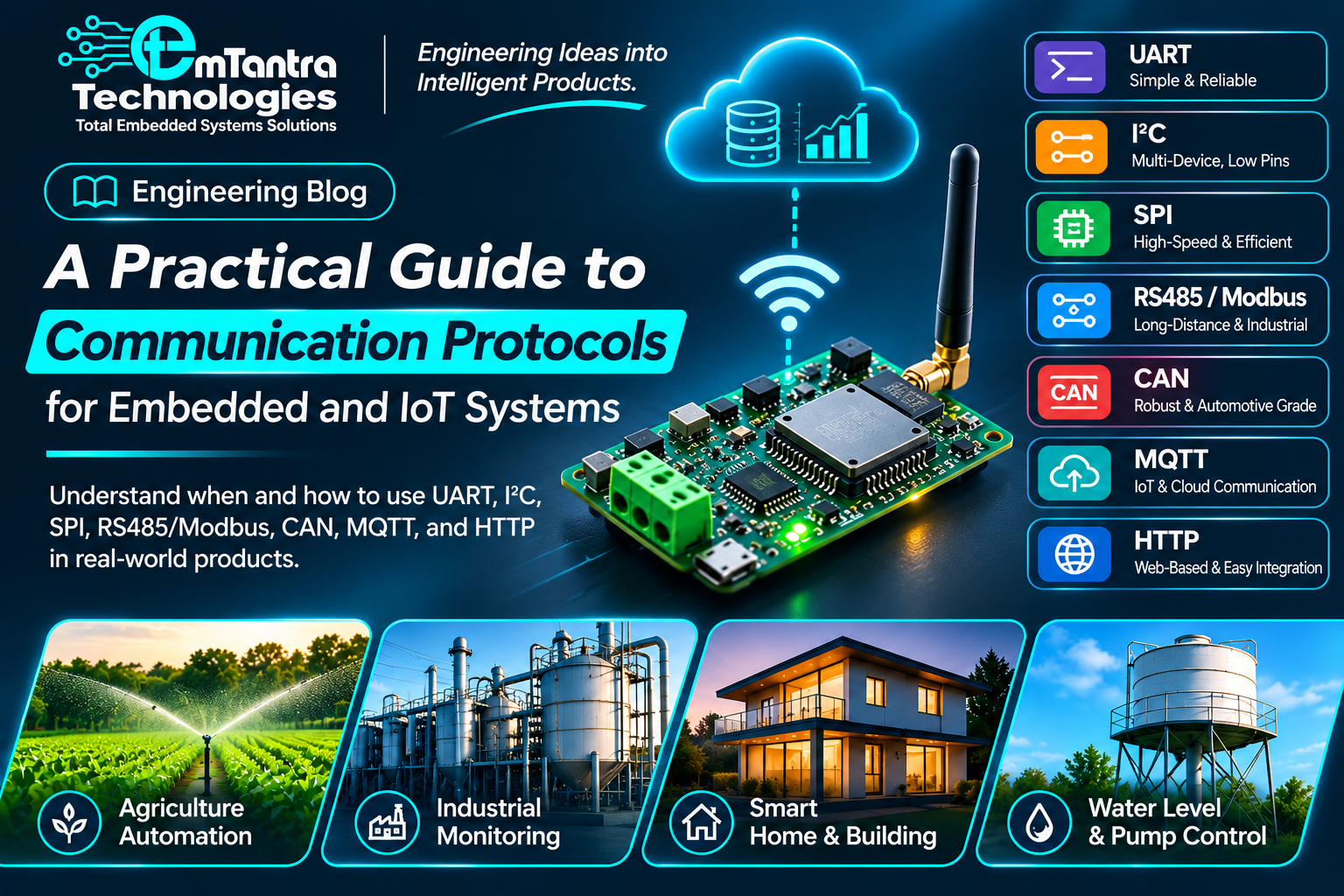
A Practical Guide to Communication Protocols for Embedded and IoT Systems

 EmTantra Technologies
·
·7 min read
·27 views
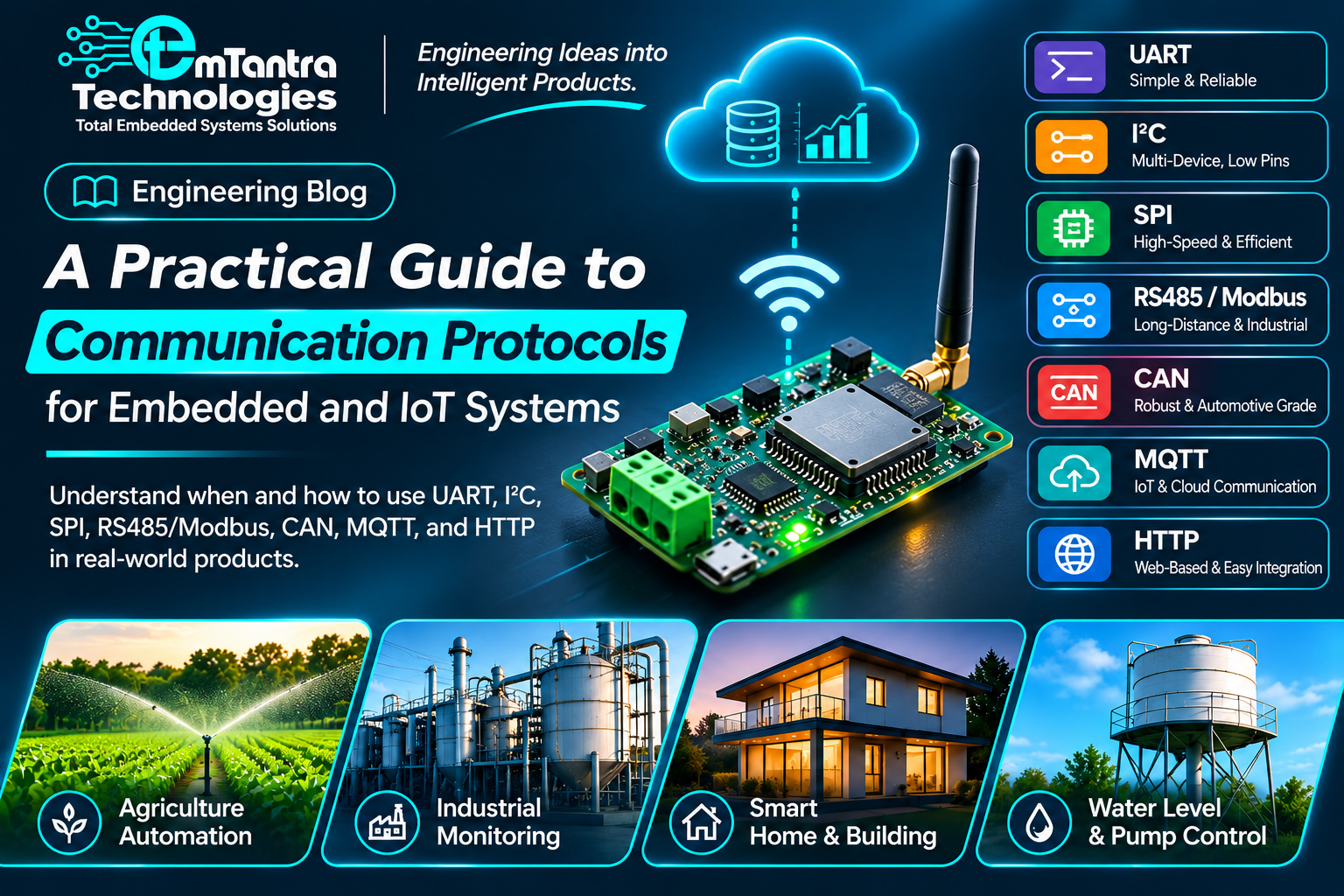
A PRACTICAL GUIDE TO COMMUNICATION PROTOCOLS FOR EMBEDDED AND IoT SYSTEMS
Communication is one of the most important parts of embedded product development. A microcontroller may collect sensor data, control outputs, and process information, but it often needs to exchange data with other electronic devices, sensors, gateways, servers, or cloud platforms.
This is where communication protocols become essential.
Different applications require different communication methods. Some need simple communication between two ICs on the same PCB, while others require reliable data transmission across industrial installations or internet-connected systems.
Understanding these protocols helps engineers select the right communication architecture for their products.
At EmTantra Technologies, communication interfaces are an important part of our embedded systems, industrial automation, and IoT product engineering work.
WHAT IS A COMMUNICATION PROTOCOL?
A communication protocol defines how electronic devices exchange information.
It specifies aspects such as data format, timing, addressing, synchronization, error detection, and communication behavior.
Protocols can be broadly classified into two groups:
- Device-level communication: Used between microcontrollers, sensors, memory ICs, and peripheral devices.
- System-level communication: Used between controllers, gateways, servers, cloud platforms, and applications.
Let’s explore some commonly used protocols.
- UART – SIMPLE SERIAL COMMUNICATION
UART stands for Universal Asynchronous Receiver-Transmitter.
It is one of the most commonly used serial communication interfaces in embedded systems.
UART generally uses two communication signals:
- TX – Transmit data
- RX – Receive data
It does not require a separate clock signal because both devices use an agreed baud rate and frame configuration.
Common applications include:
- Communication between microcontrollers
- GPS modules
- GSM and LTE modems
- Debugging and firmware logging
- Serial communication with external controllers
UART is simple to implement and useful for point-to-point communication. However, conventional UART signals are not intended for long-distance or electrically noisy industrial wiring without suitable interface hardware.
- I2C – COMMUNICATION USING TWO SIGNAL LINES
I2C stands for Inter-Integrated Circuit.
It is a synchronous serial communication protocol commonly used to connect multiple peripheral ICs to a microcontroller.
It uses two main signal lines:
- SDA – Serial Data
- SCL – Serial Clock
I2C supports device addressing, allowing multiple compatible devices to share the same bus.
Typical applications include:
- Temperature sensors
- EEPROM memory
- Real-time clock modules
- Display controllers
- Sensor modules
Its main advantage is that it requires only two signal lines for data and clock communication.
However, bus capacitance, pull-up resistor selection, device addressing, and communication speed must be considered during hardware design.
- SPI – HIGH-SPEED SERIAL COMMUNICATION
SPI stands for Serial Peripheral Interface.
It is a synchronous communication protocol commonly used when higher data-transfer rates are required between a microcontroller and peripheral devices.
Typical SPI signals include:
- MOSI – Master Out Slave In
- MISO – Master In Slave Out
- SCLK – Serial Clock
- CS – Chip Select
SPI is commonly used with:
- TFT and LCD displays
- Flash memory
- ADC and DAC devices
- High-speed sensor interfaces
- Communication modules
SPI offers high-speed communication and full-duplex data transfer in many implementations.
Its disadvantage is that it generally requires more signal connections than I2C, particularly when multiple devices need separate chip-select signals.
- RS485 – COMMUNICATION FOR INDUSTRIAL ENVIRONMENTS
RS485 is a physical-layer electrical standard widely used in industrial communication systems.
It uses differential signaling, which provides better noise immunity than conventional single-ended serial connections.
RS485 is suitable for communication over longer cable distances and in electrically noisy environments when correctly designed and installed.
Common applications include:
- Industrial controllers
- Energy meters
- Temperature controllers
- Variable frequency drives
- Industrial sensors
- Building automation systems
RS485 is frequently used with Modbus RTU, although RS485 itself does not define the application-level data protocol.
Correct termination, biasing, cable selection, grounding, and network topology are important for reliable operation.
- MODBUS – INDUSTRIAL DEVICE COMMUNICATION
Modbus is an industrial communication protocol used for exchanging data between controllers and field devices.
Two commonly used variants are:
Modbus RTU:
Uses serial communication, commonly over RS485.
Modbus TCP:
Uses Ethernet and TCP/IP networking.
Modbus organizes device data into registers and discrete inputs or coils. A client can request information or issue supported write commands to a server device.
Typical applications include:
- Energy monitoring systems
- Industrial automation
- Pump controllers
- PLC communication
- Temperature and process monitoring
- Industrial IoT gateways
Modbus is popular because it is relatively straightforward and supported by many industrial devices.
- CAN – RELIABLE COMMUNICATION BETWEEN CONTROLLERS
CAN stands for Controller Area Network.
It was originally developed for automotive applications and is now widely used in industrial and embedded systems.
CAN uses differential signaling and supports message-based communication between nodes.
Typical applications include:
- Automotive electronic control units
- Battery management systems
- Industrial controllers
- Motor control systems
- Distributed embedded systems
CAN includes mechanisms for message arbitration, error detection, and fault handling.
It is particularly useful when multiple controllers need to exchange information over a shared communication network.
- MQTT – COMMUNICATION FOR IoT SYSTEMS
MQTT stands for Message Queuing Telemetry Transport.
It is a lightweight messaging protocol commonly used in IoT applications.
MQTT follows a publish-and-subscribe communication model.
Devices publish messages to topics, while other devices or applications subscribe to those topics through an MQTT broker.
For example, an IoT controller may publish its operating status to a device-specific topic. A mobile application or server can subscribe to that topic and receive updates.
Common applications include:
- Remote equipment monitoring
- Smart home automation
- Agriculture automation
- Industrial IoT
- Cloud-connected controllers
- Telemetry and device management
MQTT is useful for connected devices, particularly when communication needs to work over networks with varying connectivity conditions.
- HTTP – WEB-BASED COMMUNICATION
HTTP stands for Hypertext Transfer Protocol.
It is widely used for communication between embedded devices, web servers, and cloud applications.
An IoT device can send measurements to a server using HTTP requests and receive responses containing configuration or control information.
Typical applications include:
- Uploading sensor data
- Device registration
- Configuration management
- Cloud API integration
- Firmware update services
- Communication with web applications
HTTP is easy to integrate with many server platforms and web applications. However, the request-response model and protocol overhead should be considered when designing low-power or bandwidth-constrained devices.
HOW TO SELECT THE RIGHT COMMUNICATION PROTOCOL?
There is no single communication protocol that is ideal for every embedded product.
The selection depends on the application and system requirements.
Consider the following:
Communication distance:
I2C and SPI are generally used for communication within a PCB or short connections. RS485 and CAN support communication across larger system installations when correctly implemented.
Data speed:
SPI is suitable for higher-speed peripheral communication. UART, I2C, CAN, and RS485-based systems have different speed and implementation constraints.
Noise immunity:
Differential interfaces such as RS485 and CAN are useful in electrically noisy environments.
Number of devices:
I2C, SPI, CAN, and RS485 networks support different approaches to connecting multiple devices.
Network connectivity:
MQTT and HTTP are useful when devices need to exchange data with servers and applications over IP networks.
Power consumption:
Battery-operated devices may require careful selection of communication technology and transmission frequency.
Cost and complexity:
The selected interface should meet the requirements without introducing unnecessary hardware or software complexity.
CAN DIFFERENT PROTOCOLS WORK TOGETHER?
Yes. Real-world embedded products often use multiple communication protocols.
Consider an industrial IoT gateway:
- A microcontroller reads local sensors using I2C.
- It communicates with an energy meter through RS485 and Modbus RTU.
- It communicates with another controller through CAN.
- It connects to a cellular or Ethernet network.
- It sends collected information to a cloud platform using MQTT or HTTP.
The gateway acts as a bridge between different communication systems.
This architecture allows existing industrial equipment to become part of a connected monitoring and automation system.
CONCLUSION
Communication protocols form the foundation of modern embedded and IoT products.
UART, I2C, and SPI are commonly used for communication between electronic components. RS485, Modbus, and CAN support communication between controllers and industrial devices. MQTT and HTTP enable connected products to exchange information with servers and applications.
Choosing the right protocol requires understanding the product’s electrical requirements, communication distance, data rate, network architecture, power consumption, and operating environment.
At EmTantra Technologies, we work with embedded systems, communication interfaces, IoT gateways, industrial monitoring, and customized electronic product development.
Have a project involving embedded communication, industrial gateways, or IoT integration?
Visit emtantra.com to explore our engineering capabilities.
EmTantra Technologies
Total Embedded Systems Solutions
Engineering Ideas into Intelligent Products.