How an IoT Device Works: From Sensor to Cloud
 EmTantra Technologies
·
·7 min read
·25 views
HOW AN IoT DEVICE WORKS: FROM SENSOR TO CLOUD
From smart irrigation systems and connected home appliances to industrial monitoring equipment, the Internet of Things (IoT) is changing how devices collect information, communicate, and respond to real-world conditions.
But what actually happens inside an IoT device?
An IoT product is more than a sensor connected to the internet. It combines electronics, embedded firmware, communication interfaces, software, and often a cloud platform or mobile application.
In this article, we explain the basic architecture of an IoT device and how data travels from a physical sensor to a connected application.
WHAT IS AN IoT DEVICE?
An IoT device is an electronic system that can sense or measure something in its environment, process the information, and communicate it to another system.
Depending on the application, an IoT device may:
- Measure temperature, pressure, humidity, voltage, current, or water level
- Monitor the operating condition of a machine
- Send data to a server or cloud platform
- Receive commands from a mobile app or remote system
- Control an output such as a relay, motor, valve, or indicator
The exact design depends on the product requirements, operating environment, power source, and communication method.
THE BASIC IoT ARCHITECTURE
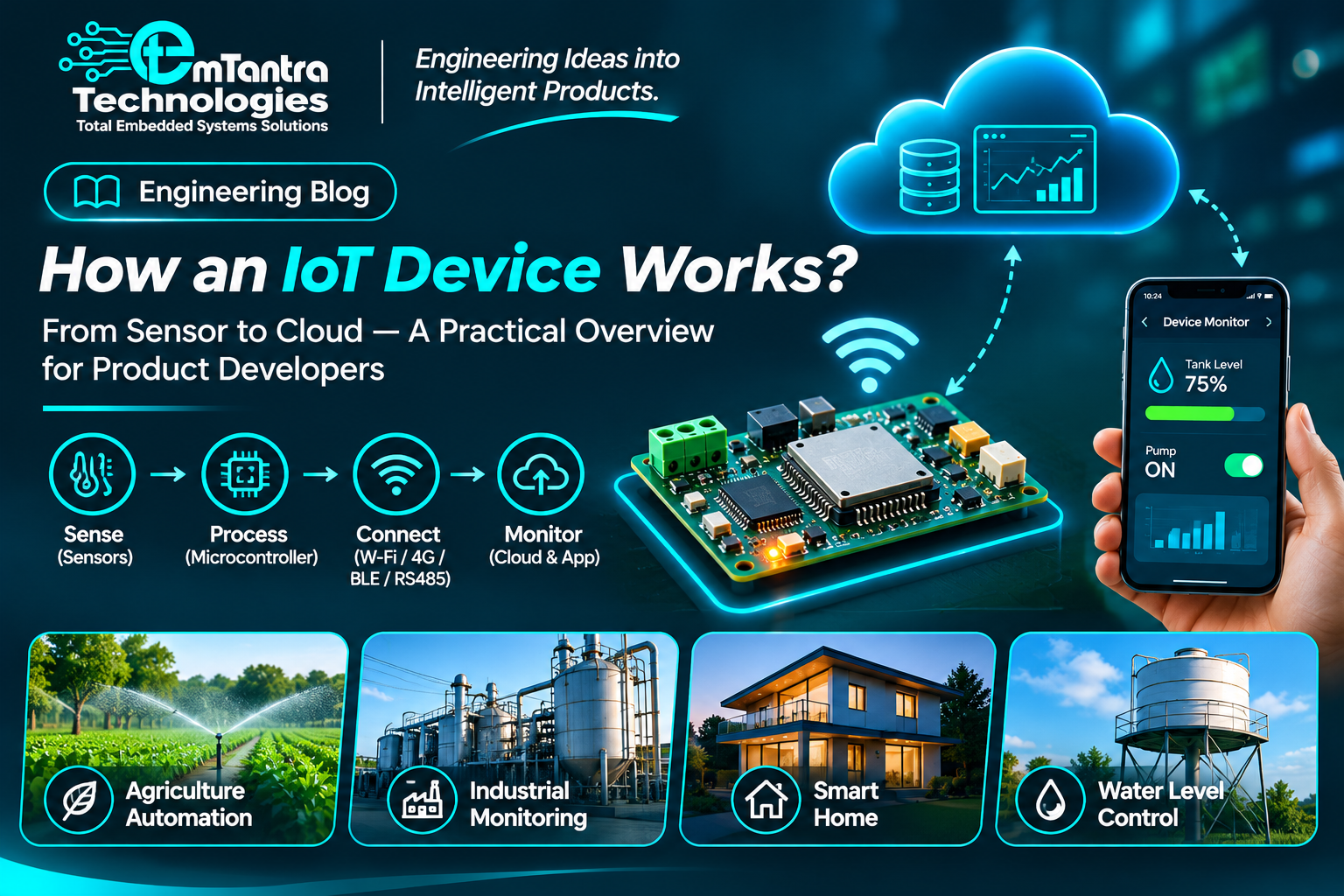
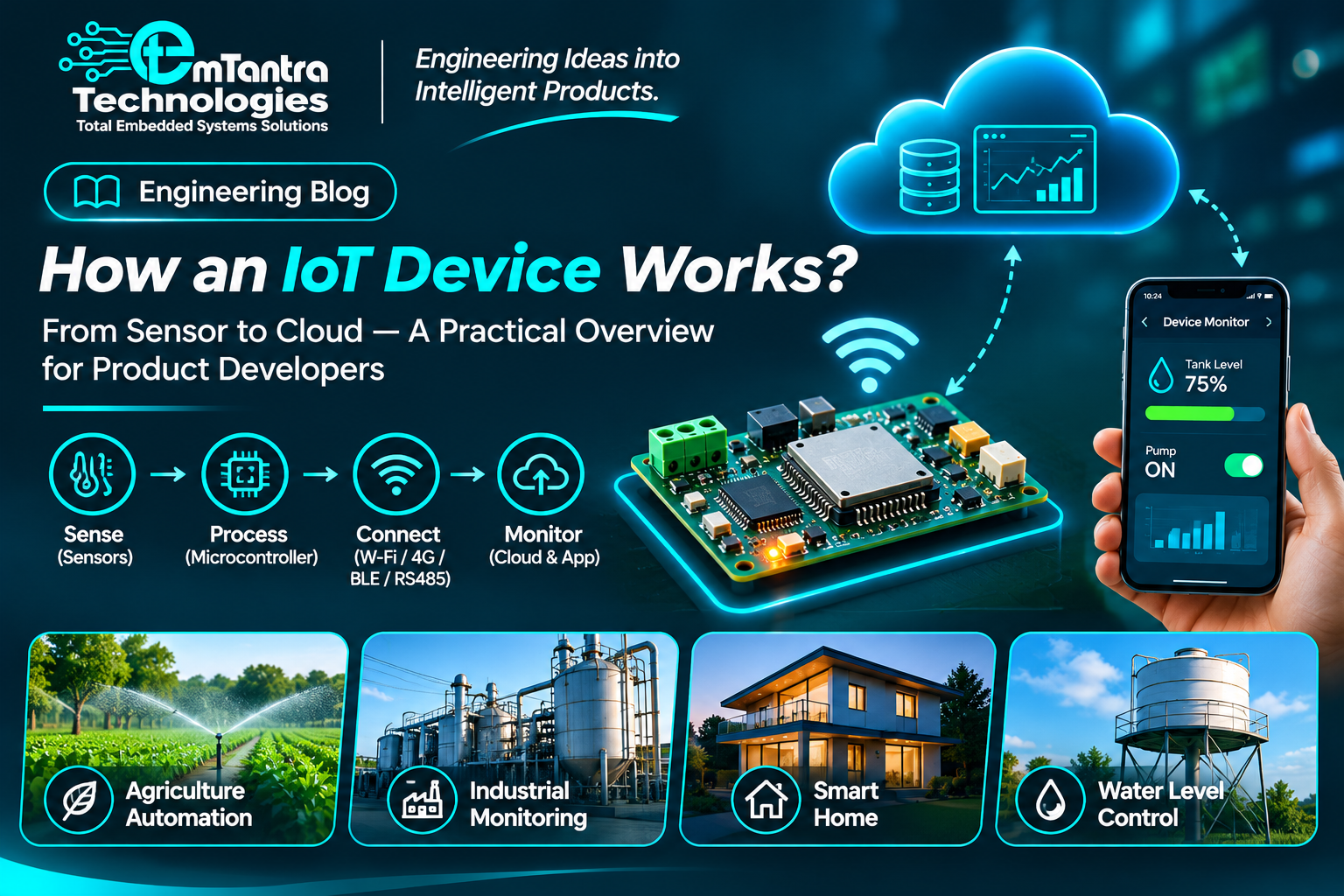
A typical IoT system can be understood through four main stages:
- Sense
- Process
- Connect
- Monitor and control
Each stage has a specific role in the complete system.
- SENSE: COLLECTING REAL-WORLD DATA
The first stage is data collection.
Sensors convert physical conditions into electrical signals that an electronic circuit can measure.
Examples include:
- Temperature sensors for equipment or environmental monitoring
- Pressure sensors for industrial processes
- Current and voltage sensors for electrical monitoring
- Water-level sensors for tanks and pumping systems
- Motion sensors for occupancy or movement detection
- Gas sensors for safety and environmental applications
The sensor output may be analog, digital, or communicated through a specific interface.
For example, an analog sensor may produce a voltage that is measured by an ADC. A digital sensor may communicate using I²C, SPI, UART, or another interface.
Correct sensor selection and signal conditioning are important for obtaining dependable measurements.
- PROCESS: THE ROLE OF THE MICROCONTROLLER
The microcontroller acts as the control unit of many IoT devices.
It reads sensor data, executes firmware, manages communication, and controls the device’s outputs.
Common microcontroller platforms include STM32, ESP32, Renesas RL78, and other MCU families. The right platform depends on the required processing capability, memory, peripherals, power consumption, cost, and development constraints.
The firmware may perform tasks such as:
- Reading sensor values
- Filtering or averaging measurements
- Applying thresholds and control logic
- Detecting faults or abnormal conditions
- Managing device configuration
- Preparing data for communication
- Controlling relays, motors, or other outputs
For example, a water-level controller may read the tank level and operate a pump when the water level reaches a defined condition.
The microcontroller does not necessarily need an internet connection to perform local control. In many products, essential functions continue operating locally even when the network is unavailable.
- CONNECT: COMMUNICATING WITH OTHER SYSTEMS
After processing the data, the device may send information to a gateway, server, or cloud platform.
The communication technology depends on the application.
Common options include:
Wi-Fi: Useful where a reliable local wireless network is available.
Bluetooth Low Energy (BLE): Suitable for short-range communication, configuration, and low-power devices.
Cellular communication such as 4G: Useful for remote equipment where Wi-Fi or wired connectivity is not available.
RS485 and Modbus: Common in industrial environments for communication between controllers, meters, sensors, and gateways.
Ethernet: Suitable for installations requiring a wired network connection.
MQTT, HTTP, and other application protocols may be used to exchange data between devices and software platforms.
Choosing a communication method involves more than checking its data rate. Range, network availability, power consumption, reliability, security, installation cost, and maintenance must also be considered.
- MONITOR AND CONTROL: CLOUD, SERVER, AND APPLICATION
A connected IoT system may send device data to a server or cloud platform.
The software can store information, display measurements, generate alerts, and provide remote access to authorized users.
A mobile or web application may show:
- Current sensor readings
- Historical data and trends
- Device online or offline status
- Fault and alert notifications
- Operating status of connected equipment
- Controls for permitted operations
For example, an IoT pump controller may report water level, pump status, voltage, and fault conditions. An authorized user can monitor the system remotely and issue a control command when the product supports it.
The server or cloud platform is not always required. Some IoT products operate locally, while others use a gateway or a private server.
HOW DATA FLOWS THROUGH AN IoT SYSTEM
Consider a connected water-level controller.
A sensor measures the water level in a tank. The microcontroller reads the sensor output and determines the current level. The firmware updates the local pump-control logic and prepares a status message.
The device then sends the status through its communication interface to a server. The application displays the water level and pump status to the user.
If the user sends a command, the server or communication system routes it to the device. The device validates the command and performs the requested action according to its firmware and safety conditions.
This creates a complete data path:
Sensor → Microcontroller → Communication Interface → Server or Gateway → Application
Control commands may travel in the opposite direction.
DESIGN CONSIDERATIONS FOR REAL IoT PRODUCTS
A successful IoT product requires careful engineering across hardware, firmware, communication, and software.
Power management
Battery-operated devices need careful power budgeting. Sleep modes, sensor duty cycles, communication time, and regulator efficiency can significantly affect battery life.
Network reliability
Wireless or cellular connectivity may be interrupted. The firmware should define how the device handles connection loss, retries, buffering, and recovery.
Data accuracy
Sensor selection, calibration, noise filtering, PCB layout, and signal conditioning influence measurement quality.
Security
IoT products should consider device identity, secure communication, access control, credential management, and firmware update security.
Local operation
For control-critical applications, essential functions should not depend entirely on cloud availability. The required local behavior should be defined during product design.
Testing and validation
The complete system should be tested under realistic operating conditions, including sensor faults, communication loss, power interruptions, and abnormal inputs.
FROM CONCEPT TO CONNECTED PRODUCT
Developing an IoT device involves several engineering activities:
- Defining product requirements
- Selecting sensors and microcontrollers
- Designing the electronic circuit
- Developing the PCB
- Writing embedded firmware
- Integrating communication interfaces
- Developing server or application software
- Prototyping and testing
- Validating reliability and preparing for production
These stages are closely connected. A decision made during hardware design can affect firmware, communication, power consumption, enclosure design, and manufacturing.
A structured product engineering process helps manage these dependencies and reduce avoidable redesign.
CONCLUSION
An IoT device brings together sensing, embedded processing, communication, and software to connect physical systems with digital applications.
Understanding the complete data path—from the sensor to the application—is essential when designing a reliable connected product.
The best IoT architecture is not necessarily the one with the most features or the newest technology. It is the architecture that meets the product’s real requirements for performance, reliability, cost, power, security, and maintainability.
At EmTantra Technologies, we work on embedded product engineering, electronics design, firmware development, IoT, and automation solutions for connected devices and industrial applications.
Have an IoT product idea or need support with embedded product development?
Visit emtantra.com
EmTantra Technologies
Total Embedded Systems Solutions
Engineering Ideas into Intelligent Products.